City guide
EV Charging Station Business in Chicago: ComEd, Ordinances and Winter Sites
EV charging station business Chicago guide: 860 public stations, a 2,500 goal for 2035, a 20% EV-ready parking rule and ComEd make-ready rebates.
- Prepared by
- EVCSTAR Engineering Team
- Published
- Reading time
- 5 min
- Sources
- 3 references
At a glance
- Public charging stations (2025 draft framework)
- 860
- City goal, public charging stations by 2035
- 2,500
- EV-ready share in new buildings (since 2020)
- 20% of spaces
- ComEd make-ready budget, 2026-2028
- $44 million
Key takeaways
- 1Chicago had 860 public charging stations and about 20,328 battery-electric registrations in 2024, according to the city transportation department's draft EV framework (April 2025); its 2022 climate plan aims for 2,500 public passenger charging stations by 2035, and most of today's chargers sit downtown or in higher-income areas, with only 7.8% in environmental justice neighborhoods.
- 2The city expects ride-hail and taxi fleets to be electric by 2030 and used a $15 million federal Charging and Fueling Infrastructure grant (September 2024) for chargers at corridors, transit hubs and sites such as Midway Airport meant to serve taxis, ride-hail and commercial fleets.
- 3Since 2020 new buildings with five or more residential units, or commercial buildings with 30 or more parking spaces, must make at least 20% of spaces EV-ready, so new developments are a lead source for hosts of Level 2 and fast chargers, though the rule does not cover existing buildings.
- 4ComEd serves the city: its second Beneficial Electrification plan commits about $168 million for 2026-2028, with $44 million for business and public make-ready rebates that cover Level 2 and DC fast sites and more than half the budget directed to low-income and equity-eligible projects.
On this page
Short answer: an EV charging station business in Chicago is a dense-city game, not a corridor game: your constraints are ComEd service capacity, parking and curb access, the city’s EV-ready building rule and winter operation, and your best customers are ride-hail drivers, taxis and fleets that need charge between shifts.
What Chicago has, and where the gaps are
The city counts 860 public stations and says they are in the wrong places. The Chicago Department of Transportation’s draft framework (April 2025, reported by Utility Dive) records battery-electric registrations rising from 1,865 in 2018 to 20,328 in 2024, and fewer public chargers per EV than the US, Illinois or Cook County ratios. Most chargers are downtown or in higher-income areas; only 7.8% are in environmental justice neighborhoods. The 2022 Climate Action Plan sets a target of 2,500 public passenger charging stations by 2035.
| City signal | Number or rule | Reading for an operator |
|---|---|---|
| Public stations (2025 draft) | 860 | Roughly a third of the 2035 goal |
| Battery-electric registrations (2024) | 20,328 | Demand is real but not yet large |
| Public chargers in EJ neighborhoods | 7.8% | Outer neighborhoods are under-served |
| Goal: ride-hail and taxi electrified | By 2030 | A fleet customer base with fixed hours |
Rideshare, taxis and depots
The most predictable load in Chicago is professional driving, and the city says it wants to serve it. The framework sets electrification of ride-hailing and taxi fleets by 2030. A $15 million federal Charging and Fueling Infrastructure award (September 2024) is meant to expand charging in high-traffic corridors, transit hubs and underserved communities, including Level 2 and fast chargers at sites such as libraries and Midway Airport, and to support electric taxis, ride-hail and commercial fleets. The city also plans to use CMAQ funding for commercial fleet electrification.
A driver who works 10 hours with no home charger needs a fast stop with a short queue, not a destination charger. That points to sites near airports, rail terminals and the downtown edge, with a reservation or priority lane for fleets. For an operator with fleet customers, the fleet depot business case shows how contracted kWh changes the numbers; for the state-level grant picture see the Illinois guide.
Curbs and the EV-ready ordinance
Chicago pushes charging into new buildings and is testing the street, which affects who hosts your chargers. The EV-ready ordinance approved on 24 April 2020 applies to new residential buildings with five or more units and commercial buildings with 30 or more parking spaces: at least 20% of spaces must be ready for charging equipment, and at least one of those must be accessible. It does not apply to existing buildings. So the stream of hosts is developers and garage owners adding capacity at construction, who often want a turnkey operator, rather than owners of older lots.
The draft framework also describes a curbside charging pilot for residents who rely on street parking, testing public-private partnerships in the right-of-way with utilities, developers and EV companies, with formal permitting guidelines to follow. The draft was open for comment in April 2025; whether the pilot and guidelines have been adopted and in what form we could not confirm. Treat curbside as a future option and ask the Chicago Department of Transportation for the current permitting status.
ComEd: service, rebates and rates
ComEd is the single gatekeeper for capacity in the city, so start the load request first. The Illinois Commerce Commission approved ComEd’s second Beneficial Electrification plan: about $168 million over 2026 to 2028, of which $44 million is the Business and Public Sector Make-Ready Program, rebates for the cost of preparing business and public sites for Level 2 or DC fast charging equipment (Choose DuPage, June 2025). Rebate amounts may change with demand, and projects in or primarily serving low-income or Equity Investment Eligible Communities get higher rebates and more than half the budget. A separate $82 million program covers fleet EV purchases.
We could not open ComEd’s current rebate table or delivery tariffs, so take no per-kW figure from this page. Ask ComEd two specific questions: what the make-ready rebate is for your site type today, and whether an alternative delivery option to demand-based pricing for separately metered EV charging is open for a DC fast site, since demand charges decide the payback. The demand charge guide shows how to test both cases, and the Illinois page explains how Ameren differs outside the ComEd territory.
Winter operation in a dense city
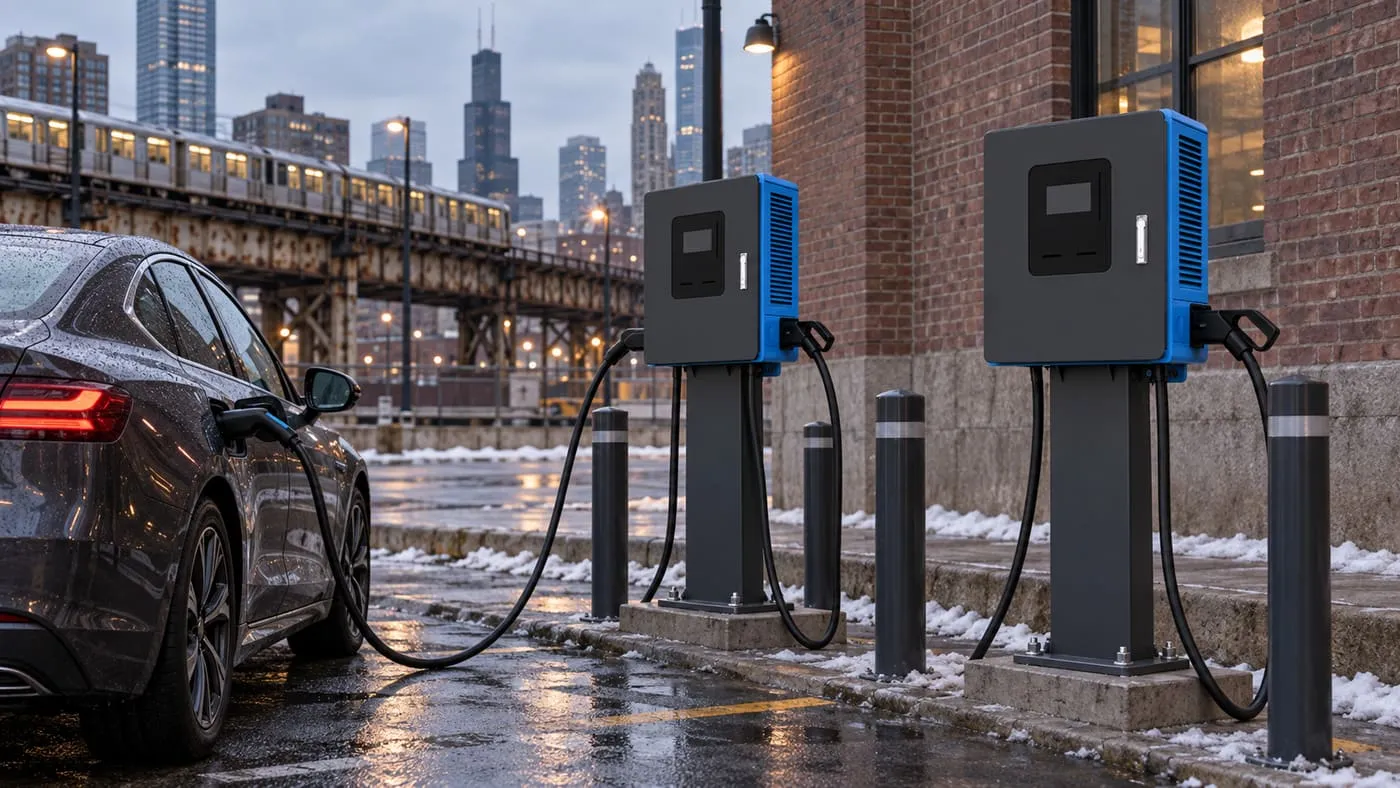
Winter performance is specified on the data sheet and tested on the site. The factory data sheet for our North American UC build lists an operating range of -25 °C to +55 °C with a Type 3R enclosure. Compare that range with the design low from your engineer or the National Weather Service for the site, and ask us about cabinet heating, cable-holder design and display behaviour in cold. In a city, plan for plough piles at the kerb and salt spray on cabinets and connectors, put bays where snow is not pushed, and write response times for cable and connector faults into the maintenance contract. Cold slows charging itself, so expect fewer kWh per car-hour in January and model utilisation by season.
Matching equipment to a Chicago site
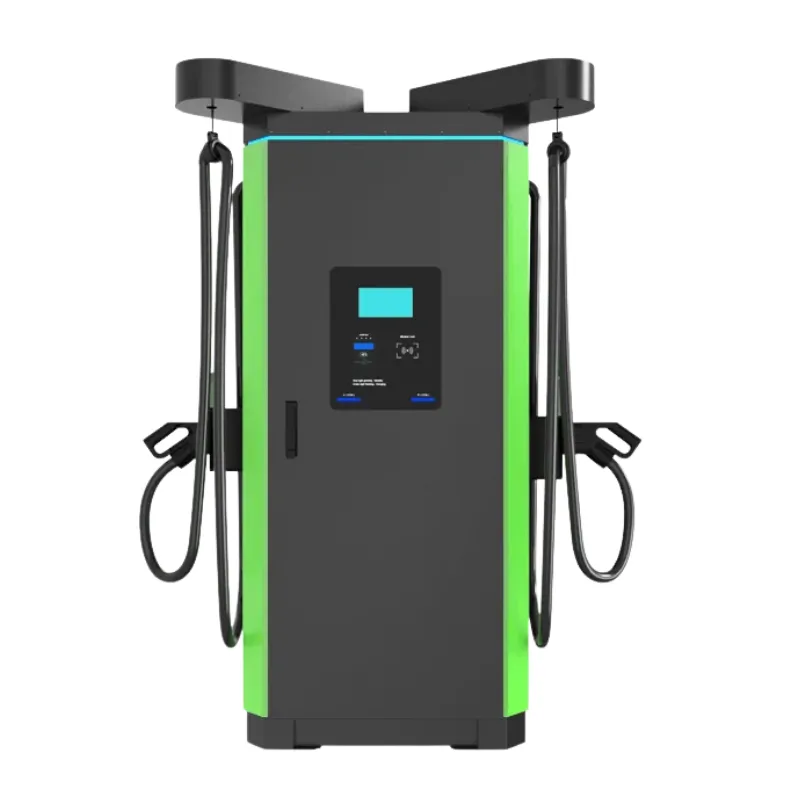
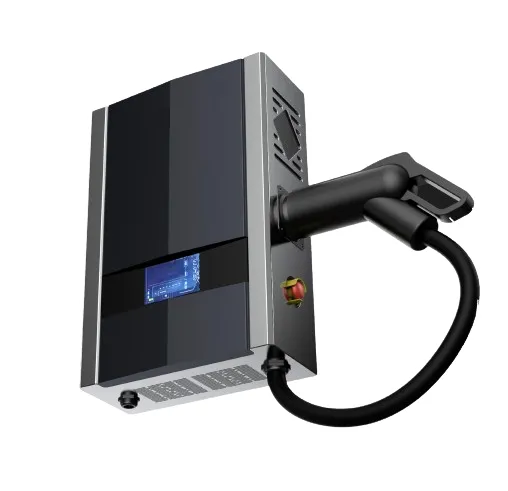
Chicago needs the North American build: 480 V input with CCS1 or NACS connectors, in the UC and SC series only. The UC series fits a taxi and ride-hail hub: two guns on one cabinet, each limited to 200 A, so roughly 200 kW per gun at 1,000 V and less on a 400 V car, and no single car takes the full 360 kW. The SC series suits garages and smaller footprints where ComEd can offer only limited capacity.
Price depends on the configuration: power level, connectors and cable length, payment hardware, and the site. Send your service voltage, the capacity ComEd has offered, the number of guns and the connector standard through the contact page, and we will reply with a configuration and itemised quotation. We can supply test reports and technical files to support listing and local inspection; confirm requirements with the City of Chicago and the electrical inspector.
Payback calculator
Example values are filled in — replace them with your own quotation, tariff and traffic figures.
- Energy sold per month
- —
- Net margin per month
- —
- Simple payback
- —
Simple payback = total investment ÷ (energy sold × (price − energy cost) − fixed costs), using 30 days per month. Taxes, financing, subsidies and utilisation growth are not included.
Frequently asked questions
- Who connects an EV charging site in Chicago to the grid?
- ComEd serves Chicago and most of northern Illinois. A new service or a larger service for a fast-charging site is requested from ComEd with the site's kW load, and the lead time and any distribution upgrade cost come back in its response. We did not find a published Chicago lead time, so ask for one in writing before you sign a lease.
- Does Chicago require new parking lots to have EV charging?
- Since the ordinance approved on 24 April 2020, new construction of residential buildings with five or more units and commercial buildings with 30 or more parking spaces must provide EV-ready infrastructure for at least 20% of spaces, with at least one accessible space; the ordinance does not apply to existing buildings. EV-ready means panel capacity, circuit, conduit and wiring are in place; it does not mean a charger is installed.
- Can ComEd help pay for a fast-charging site?
- ComEd's approved 2026-2028 plan includes a $44 million make-ready program for business and public sites, covering Level 2 and DC fast charging equipment preparation, with rebate amounts that can change with demand and higher rebates for low-income and equity-eligible communities. Check the current rebate table and application rules with ComEd before you design around a figure.
- Which EVCSTAR charger fits a Chicago site?
- The North American build, available only in the UC and SC series: 480 V three-phase input with CCS1 or NACS connectors. UC suits hubs and depots; SC suits smaller sites with limited supply. Price depends on configuration, so send your voltage, number of guns, connector standard and the capacity ComEd has offered through the contact page and we will return a configuration and itemised quotation.
References
- [1]More public EV charging, including curbside, envisioned in Chicago plan. Utility Dive, on the Chicago Moves Electric draft framework, April 2025.
- [2]Chicago requires new residential, commercial construction to include EV charging. Utility Dive, 28 April 2020.
- [3]ComEd receives approval for Beneficial Electrification Plan 2. Choose DuPage, 3 June 2025.