Province guide
DC Fast Charging in Alberta: Deregulated Power and Highway Corridors
DC fast charging Alberta business guide: pool price averaged $43.68/MWh in 2025, demand-based wires charges, a 24-site corridor build and cold-site checks.
- Prepared by
- EVCSTAR Engineering Team
- Published
- Reading time
- 4 min
- Sources
- 7 references
At a glance
- Average pool price (2025)
- $43.68/MWh
- Winter peak load record (Dec 2025)
- 12,785 MW
- SureCharge corridor plan
- 24 sites / 96 points
- ZEVIP funding for that network
- $4.7 million
Key takeaways
- 1Alberta is an energy-only market: the average pool price fell 30% to $43.68/MWh in 2025 (AESO), but the wires side of the bill is separate, regulated and, for ATCO Electric and FortisAlberta territory, partly demand-based.
- 2A fast-charging site is billed for its peak kW through distribution and transmission charges, so a lightly used 180 kW or 360 kW cabinet can carry demand costs far above its energy use. A 2022 Electric Autonomy review noted that ATCO Electric offered a temporary energy-based rate (D23) for separately metered fast-charging sites up to 500 kW; its current status is unconfirmed.
- 3Corridor build-out is under way: SureCharge plans 24 sites and 96 charging points of 180 kW along Alberta and British Columbia travel corridors, backed by $4.7 million of federal ZEVIP money, with the full first phase targeted for December 2026.
- 4Cold is a data-sheet question: the North American UC cabinet is listed from -25 °C to +55 °C, so check your site's design low temperature against that before ordering.
On this page
Short answer: DC fast charging in Alberta for a business comes down to two bills that behave differently: a cheap, volatile energy price from the deregulated pool, and regulated wires charges that, in ATCO Electric and FortisAlberta territory, bill your peak kilowatts whether or not cars are plugged in.
Two separate prices: energy and delivery
Alberta unbundles the bill, so an average pool price tells you only part of the story. The AESO reports that the 2025 average pool price was $43.68/MWh, down 30% from $62.78/MWh in 2024, which it ties to new efficient gas generation and more wind and solar. The same report records a new winter peak of 12,785 MW in December 2025. Energy for a commercial site can be bought through a retailer contract or left floating on the pool; for a site that charges mostly in daytime and early evening, a fixed contract is a risk decision, not a technology one.
Delivery is the part you cannot shop around. The Utilities Consumer Advocate explains that the Alberta Utilities Commission regulates transmission rates and the distribution rates of ENMAX (Calgary), EPCOR (Edmonton), FortisAlberta and ATCO Electric, while Red Deer, Lethbridge, Cardston and Ponoka councils and the rural electrification associations set their own.
| Layer | Who sets it | Billing basis for a DC site |
|---|---|---|
| Energy | Market (pool) or retailer contract | Per kWh |
| Distribution | AUC-regulated utility, or municipal council / REA | Demand-based (kW per day) in ATCO Electric and FortisAlberta territory; confirm for others |
| Transmission | AUC-approved tariff passed through | Energy plus demand level (kW) in ATCO Electric and FortisAlberta areas |
| Riders | Utility, adjusted yearly | Added to distribution and transmission |
Why a quiet fast charger still costs money
Demand-based delivery charges punish low utilisation, which is exactly a new corridor site’s first two years. The Electric Autonomy series on demand charges describes the effect for DC fast stations across Canada, and notes that Alberta’s ATCO Electric introduced a temporary rate, D23, for separately metered fast-charging stations with loads of 500 kW or less, converting the demand component into an equivalent per-kWh charge. That was reported in 2022; whether D23 is still open, or has been replaced, must be confirmed with ATCO Electric. FortisAlberta is reported to have an interim EV fast-charging rate of its own, which we could not open. Use the demand charge guide and the grid capacity calculator to compare a 150 kW site with a 360 kW cabinet before you decide how much capacity to ask for. Asking for more kW than the first years of traffic justify is the most expensive mistake on a rural feeder.
The corridor map as it is being drawn
The highway network is being built by new operators using 180 kW cabinets, and the gaps they leave are the opportunity. SureCharge Corp. plans 24 sites with 96 charging points using Wallbox Supernova 180 kW chargers, installed by the Calgary firm SureTek, with $4.7 million from ZEVIP (Electric Autonomy, October 2025). CleanTechnica (October 2025) lists planned Alberta locations including Red Deer, Lacombe, Edson, Hinton, Jasper, Whitecourt, Grande Cache, Valleyview, Grande Prairie, Rocky Mountain House, Drayton Valley and Provost, with the full first phase targeted for December 2026. We could not confirm which sites are open now.
Three consequences for a newcomer:
- Spacing matters more than headline power. On a long, thin corridor, a reliable site every 100 to 150 km that works at the worst temperature beats a faster site that is down in January.
- Town sites and highway sites are different customers. An urban site is built on repeat local users; a corridor site depends on through traffic. Model the two with different utilisation assumptions in the payback calculator.
- Connection waits decide the schedule. Rural feeders and line extensions are quoted by the utility, and we found no published Alberta timeline. Request the quote before you sign a lease.
Cold, from the cabinet’s point of view
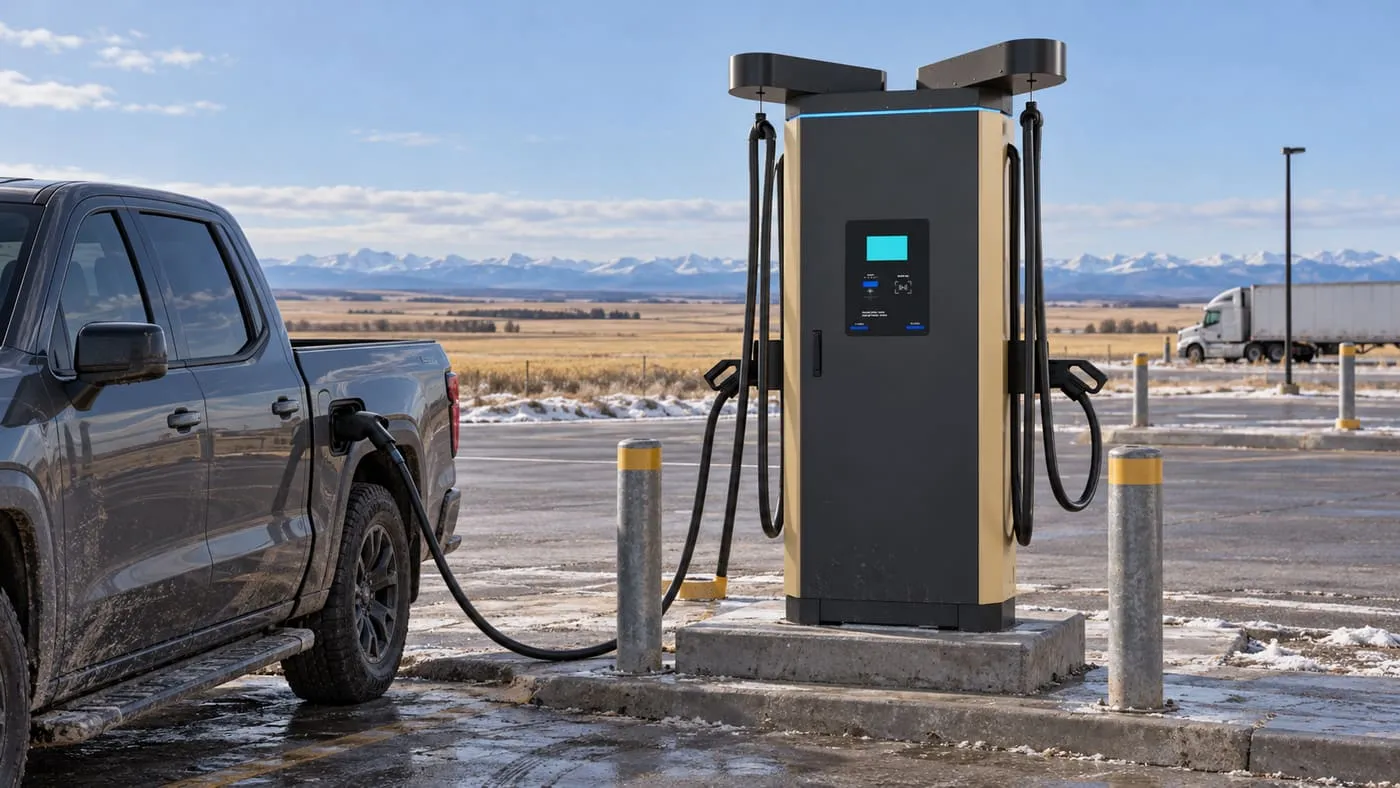
Alberta cold should be handled as a specification line, using only the numbers on the data sheet. The factory data sheet for the North American UC build lists an operating range of -25 °C to +55 °C, Type 3R enclosure. Check your site’s design low temperature (from Environment Canada records for the nearest station, or from your engineer) against that range, and ask us about cabinet heating, cable-holder design and display behaviour in cold before ordering. Plan snow clearing around bays and keep cables off the ground where a plough will meet them. Cold also slows charging for the car itself, so the same cabinet delivers less energy per car-hour in January than in July; build that into the payback case.
Choosing equipment for an Alberta site
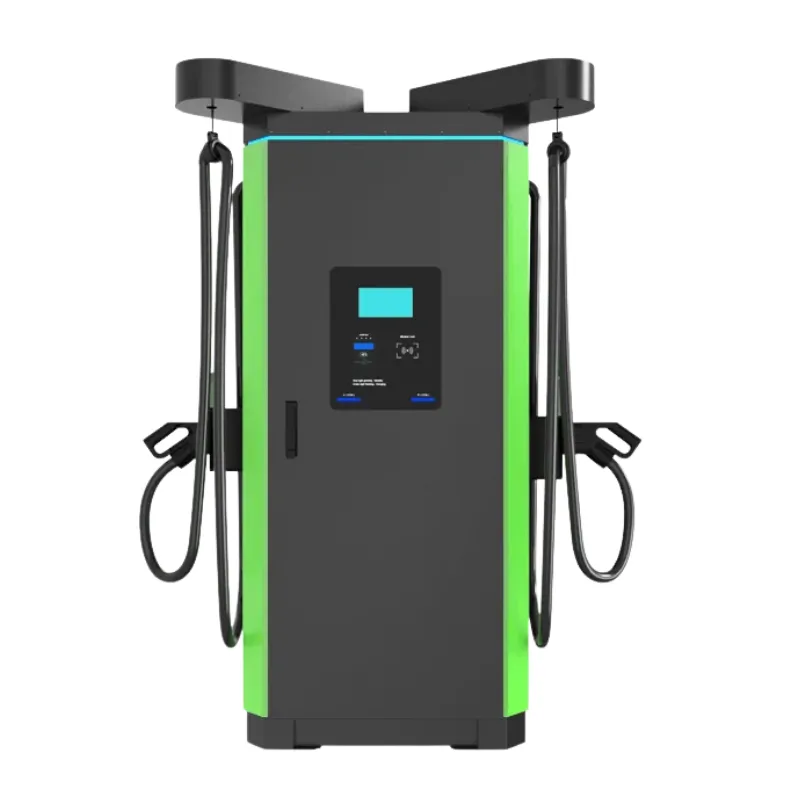
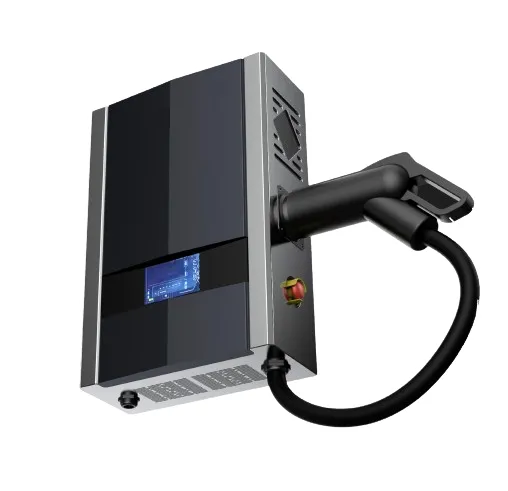
The Alberta build is the North American one: 480 V input with CCS1 or NACS connectors, available only in the UC and SC series. For a highway or edge-of-town hub, the UC series puts two guns on one cabinet, each limited to 200 A, which is roughly 200 kW per gun at 1,000 V and less on a 400 V vehicle, so no single car draws the full 360 kW. For a small-town site with limited supply, or a first phase that you expect to expand, the SC series wall units take less capacity. Compare the case with Ontario’s rate structure on the Ontario page and British Columbia’s on the British Columbia page.
Price depends on the configuration: power level, cable and connector mix, payment hardware and site conditions. Send us your voltage, number of guns, connector standard and the capacity your distributor has offered through the contact page, and we will return a configuration and itemised quotation. We can supply test reports and technical files to help with Canadian field approval; confirm requirements with the authority having jurisdiction for your site.
Grid capacity calculator
- Spare power for charging
- —
- Input current per charger (400 V)
- —
- Chargers at full power
- —
Spare power = kVA × 0.95 power factor × (1 − margin) − existing peak load. Input current ≈ charger kW ÷ (√3 × 400 V), with power factor and 95 % efficiency added for DC chargers. With dynamic load management more chargers can share the same capacity at reduced power. Always confirm with your electrical engineer and the grid operator.
Frequently asked questions
- Does Alberta's deregulated market mean a fast-charging site can buy cheap power?
- Partly. Energy is bought at the pool price or on a retailer contract, and the pool averaged $43.68/MWh in 2025, but the wires charges are regulated by the Alberta Utilities Commission and are billed separately. The Utilities Consumer Advocate lists distribution demand charges per kW per day for ATCO Electric and FortisAlberta customers, and transmission charges in those areas depend on kW as well as kWh. Ask the distributor for the rate class a separately metered DC site would be placed in.
- Which Alberta distribution tariff applies to an EV charging site?
- It depends on the territory (ENMAX in Calgary, EPCOR in Edmonton, FortisAlberta and ATCO Electric in much of the rest) and on site size. FortisAlberta is reported to list an interim EV fast-charging rate, and ATCO Electric offered a temporary one in 2022, but we could not open either tariff, so confirm which rate your account would receive and whether it is still in force.
- Is there provincial or federal money for a new Alberta site?
- Federal ZEVIP supported the SureCharge corridor network with $4.7 million; the national program position is on the Canada page. We found no current Alberta-only grant for commercial DC sites that we could confirm, so build the case without one and add funding only against a signed agreement.
- Which EVCSTAR charger suits an Alberta site?
- The North American build, available only in the UC and SC series: 480 V input with CCS1 or NACS connectors. Price depends on configuration; send your voltage, gun count, connector standard and available capacity through the contact page and we will return a configured quotation.
References
- [1]AESO 2025 Annual Market Statistics. Alberta Electric System Operator, March 2026.
- [2]Wholesale Market Report: Q4 2025. Alberta Market Surveillance Administrator, 13 February 2026.
- [3]Small business electricity delivery charges. Utilities Consumer Advocate, Government of Alberta.
- [4]Electricity transmission and distribution charges. Utilities Consumer Advocate, Government of Alberta.
- [5]Understanding Demand Charges Part 2. Electric Autonomy Canada, March 2022.
- [6]Federal and provincial investments fuel EV charging expansion across Canada. Electric Autonomy Canada, October 2025.
- [7]Up to 96 fast charging EV ports to be installed in Alberta and British Columbia. CleanTechnica, 6 October 2025.