State guide
Illinois Fast Charging Business: ComEd, Ameren and Winter Performance
DC fast charging Illinois business guide: 91 NEVI projects awarded in three rounds, $300/kW Ameren line extension allowance, ComEd territory and winter checks.
- Prepared by
- EVCSTAR Engineering Team
- Published
- Reading time
- 4 min
- Sources
- 5 references
At a glance
- NEVI rounds 1–3
- 91 projects, 489 ports
- NEVI round 4 funding
- ~$30M (closed 20 Jul 2026)
- NEVI site rule
- 4 ports, 150 kW, 97% uptime
- Ameren line extension adder
- $300/kW (+ up to $500/kW)
Key takeaways
- 1Illinois has run four NEVI rounds through IDOT: rounds 1 to 3 conditionally awarded 91 projects and 489 new ports, and round 4 (about $30 million) closed on 20 July 2026, with applicants to be contacted in September.
- 2NEVI sites need at least four DC ports with 150 kW of combined simultaneous power, 24-hour availability and 97% annual uptime within one mile of an Alternative Fuel Corridor (IDOT), so a corridor site is a four-port design from day one.
- 3Two utilities define the economics: Ameren Illinois lists a $300/kW supplemental line extension allowance for stand-alone EV charging, with up to $500/kW more in equity or low-income areas, while ComEd (northern Illinois) runs its own make-ready and EV delivery-rate offers that we could not open.
- 4Illinois winters are a specification issue: the charger's lowest operating temperature, connector heating and snow clearance are questions for the data sheet; EVCSTAR publishes a +55 °C upper limit, but check the low end for the exact model.
On this page
Short answer: a DC fast charging business in Illinois is mostly a question of which utility connects the site and whether you can attach NEVI or other grant money, because the state has already awarded 91 NEVI projects and the next round closed on 20 July 2026.
NEVI in Illinois: four rounds and a long rulebook
IDOT treats NEVI as a corridor program with hard technical rules. The department’s page lists three awarded rounds, all conditional on grant agreements, and a fourth that pre-qualifies locations.
| Round | Announced | Projects | New ports | Funding |
|---|---|---|---|---|
| 1 | 9 September 2024 | 37 | 182 | $25.3 million |
| 2 | 17 September 2025 | 25 | 167 | $18.4 million |
| 3 | not stated | 29 | 140 | not stated |
| 4 | applications closed 20 July 2026 | pending | pending | about $30 million |
Round 3 widened eligibility to U.S. routes, scenic byways and medium- and heavy-duty charging. For the initial build-out, chargers must be within one mile of an Alternative Fuel Corridor and no more than 50 miles apart; each site needs at least four DC fast ports with at least 150 kW of combined simultaneous power, 24-hour availability and 97% annual uptime, under federal rules in 23 CFR Part 680. IDOT says the next phase, after corridors are fully built, would allow DC fast and Level 2 chargers statewide. The 2025 awards followed a court ruling that ordered the release of withheld funds to Illinois and 13 other states (Electrek). Treat a conditional award as a conditional award: read the grant agreement.
Ameren Illinois: central and southern Illinois
Ameren’s tools are aimed at the connection, which is often the largest unknown on a rural or small-city site. A summary of Ameren’s Beneficial Electrification program lists a supplemental line extension allowance of $300 per kW of connected EVSE load for a stand-alone EV charging service, additional funding of up to $500/kW in Equity Investment Eligible or low-income communities, and access to the EVCP Rider for non-residential customers installing charging for business or public use. Work has to be done by an Ameren Illinois Electric Vehicle Partner, and make-ready rebates may apply depending on customer type.
A rough example of the allowance (our arithmetic, not an Ameren quote): a four-port site with 4 x 150 kW of connected load would be 600 kW, so $300/kW is $180,000 of supplemental allowance before any equity adder. Whether the allowance is based on nameplate or on managed load, and how the EVCP Rider prices demand, must be confirmed in the tariff. Ameren’s April 2026 release reports public charging projects in its pipeline rising from 52 (end of 2024) to 179 (end of 2025) and non-residential participating locations rising from 1 to 43. The tariff behind this dates to the 2021 Illinois Commerce Commission approval, which included a non-corridor fast DC component and noted fewer than 60 public stations in the territory at that time.
ComEd: the Chicago region
ComEd is the utility for most of northern Illinois and its programs differ from Ameren’s. Search summaries of ComEd pages describe a make-ready rebate for business and public customers and an EV charging delivery-rate option introduced in 2023 as an alternative to demand-based delivery rates, but the ComEd pages could not be opened in our review, so we give no amounts. Ask ComEd for the current make-ready rebate terms, whether the delivery-rate option fits a high-power DC site (it was described as aimed at low early utilisation) and the lead time for a new service. Run the answer in the payback calculator.
Winter: what to demand in the specification
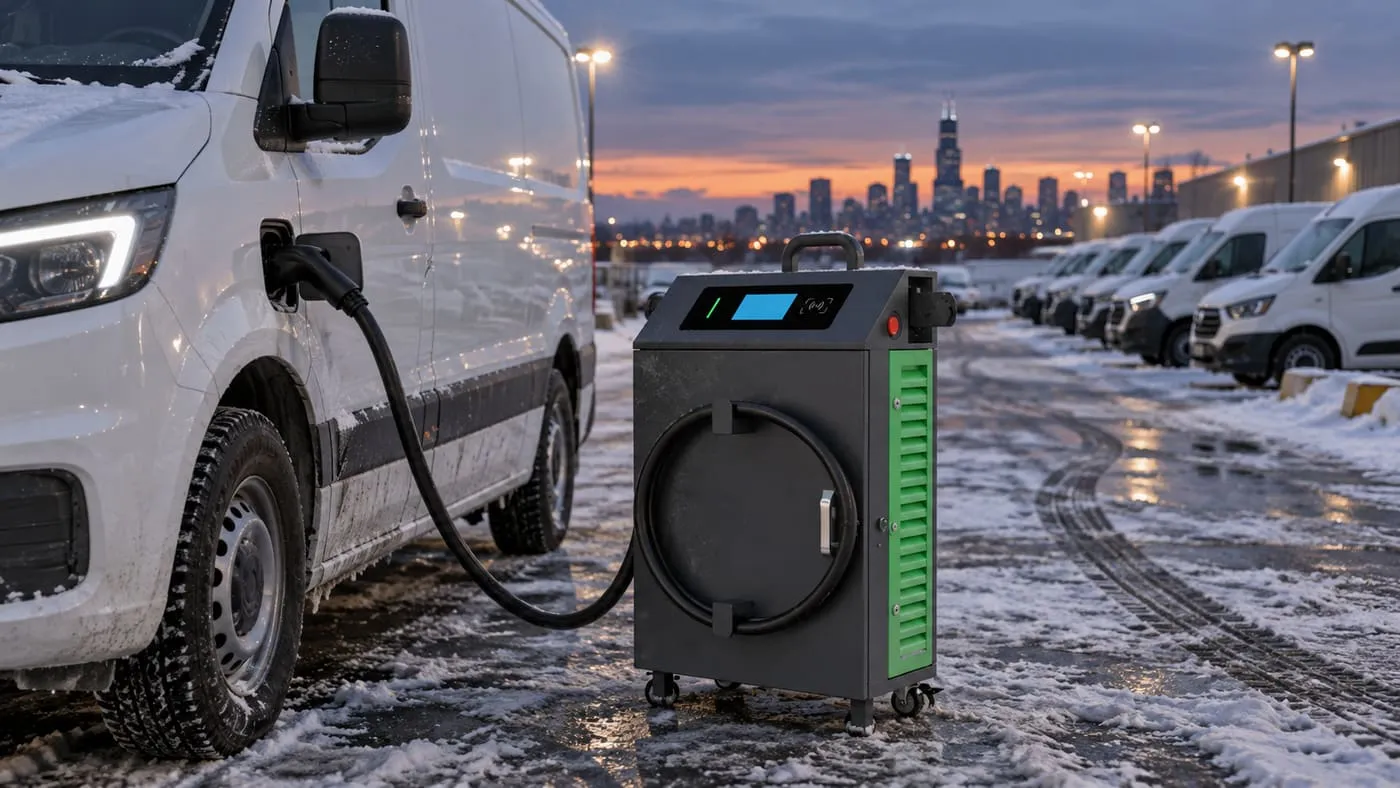
Illinois cold is a procurement item, not a footnote. We found no state source that sets a design temperature, so use the local January design value from your inspector or a weather service and ask the manufacturer for: the minimum operating temperature on the data sheet, power derating at low temperature, heating of the cabinet and connector, cable stiffness and holster design, and the clearance needed for snow ploughs. EVCSTAR publishes +55 °C as the upper limit for its chargers; confirm the lower limit for the exact model before specifying it. Also confirm 97% uptime is realistic when planning a NEVI site, because freezing weather is the first test of that number.
US listing and funding rules
Public programmes and inspectors will ask for a US safety listing. UL 2594 applies to AC supply equipment and UL 2202 to DC chargers; connectors on new builds are CCS1 and NACS. Federal funding adds rules such as domestic-content requirements that we have not verified here. Read the solicitation and see our standards guide.
How EVCSTAR equipment fits
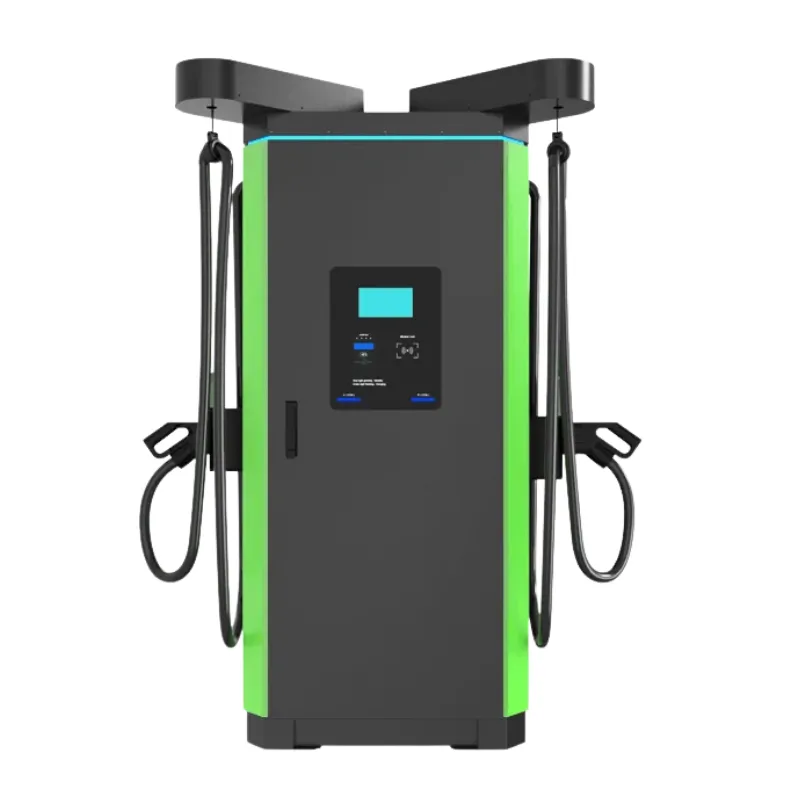
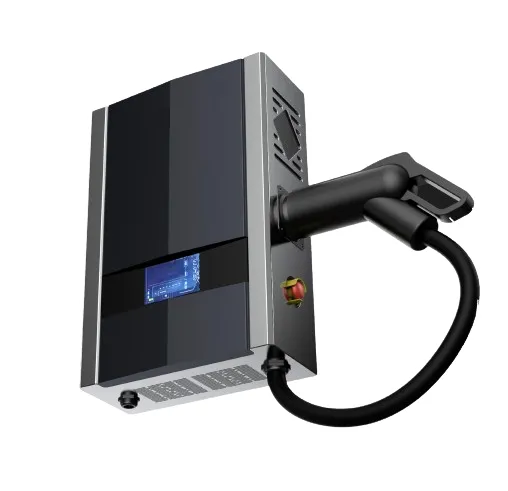
Only the UC series (60–360 kW) and the SC series (15–30 kW) have North American builds (480 V input, CCS1 and NACS). A NEVI-style four-port, 150 kW site is a UC application, with dynamic power sharing between guns; SC suits a small depot or multifamily site where the connection is limited and 150 kW is not on offer. Both support OCPP 1.6J and 2.0.1. We cannot state that any model meets the NEVI uptime rules, holds a UL or ETL listing, or satisfies Buy America; ask us for the test reports and technical documents we can supply, then confirm with IDOT, the utility and the inspector before you order.
Grid capacity calculator
- Spare power for charging
- —
- Input current per charger (400 V)
- —
- Chargers at full power
- —
Spare power = kVA × 0.95 power factor × (1 − margin) − existing peak load. Input current ≈ charger kW ÷ (√3 × 400 V), with power factor and 95 % efficiency added for DC chargers. With dynamic load management more chargers can share the same capacity at reduced power. Always confirm with your electrical engineer and the grid operator.
Frequently asked questions
- How many NEVI awards has Illinois made and what does a site need?
- IDOT lists conditional awards of 37 projects and 182 ports (announced September 2024), 25 projects and 167 ports ($18.4 million, September 2025) and 29 projects and 140 ports in round 3, which totals 91 projects and 489 ports by our sum. Initial build-out sites must be within one mile of an Alternative Fuel Corridor, spaced no more than 50 miles apart, with at least four DC ports delivering at least 150 kW combined, 24-hour access and 97% annual uptime, under 23 CFR Part 680. Round 4 closed on 20 July 2026.
- Which utility serves a site in Illinois, and does it matter?
- Yes. Northern Illinois including Chicago is served by ComEd, and central and southern Illinois largely by Ameren Illinois, and each has its own rates and programs. Ask the utility that serves the parcel, not the one that serves the nearest town, for a load letter and the cost of the service extension.
- What does Ameren Illinois offer for EV charging connections?
- A summary of the Beneficial Electrification line extension program lists a supplemental allowance of $300 per kW of connected EVSE load for a stand-alone charging service, up to $500/kW additional in equity-investment-eligible or low-income communities, access to the EVCP Rider for non-residential customers, and a requirement that work be done by an Ameren Illinois Electric Vehicle Partner. Ameren reports that its partners grew from 87 in 2023 to 178 at the end of 2025. Confirm current terms in the tariff.
- Can the same charger serve a freezing Illinois winter?
- It depends on the model. We publish a +55 °C maximum ambient for all EVCSTAR chargers, but we have not stated a minimum in this guide; ask for the low-temperature rating, heating arrangements for the cabinet and connector, and the cable-handling design, and compare them with the local January design temperature from the inspector or a weather service.
References
- [1]National Electric Vehicle Infrastructure (NEVI) Program. Illinois Department of Transportation.
- [2]Illinois awards $18.4M in restored NEVI funds to build EV charging stations. Electrek, 19 September 2025.
- [3]Ameren Illinois Beneficial Electrification line extension program. ChargePoint incentive listing (summarising Ameren Illinois).
- [4]Ameren Illinois drives major gains in electric vehicle adoption and charging access. Ameren Illinois, 1 April 2026.
- [5]Illinois approves EV charging plan. The Shop magazine, 9 July 2021.