State guide
New Jersey Fast Charging: PSE&G Make-Ready and Dense-Site Planning
DC fast charging New Jersey business guide: PSE&G $166M make-ready (1,000 DCFC target), JCP&L $25,000 per port, BPU corridor grants up to $50,000 per charger.
- Prepared by
- EVCSTAR Engineering Team
- Published
- Reading time
- 4 min
- Sources
- 3 references
At a glance
- PSE&G programme (BPU, Jan 2021)
- $166M, six years
- PSE&G DC fast budget share
- About $45M
- JCP&L DC fast grant (2022)
- Up to $25,000 / port
- BPU corridor grant (May 2025)
- Up to $50,000 / charger
Key takeaways
- 1New Jersey incentives are layered by territory: PSE&G's BPU-approved $166 million make-ready programme (approved January 2021, six years) budgeted about $45 million for DC fast chargers, and JCP&L's EV Driven offers up to $25,000 per DC fast port; confirm which is open to new applicants.
- 2In both utility programmes the customer buys and owns the charger; the utility pays for upgrades on its side and some customer-side costs, so the grant does not replace the equipment budget.
- 3The BPU's EV Tourism Corridor Program (7 May 2025) pays up to $50,000 per DC fast charger within 1 mile of an eligible corridor, with a 50% bonus (up to $75,000) in overburdened municipalities, reviewed on a rolling basis.
- 4Dense sites change the design: compact DC units and shared power cabinets matter when you have a handful of parking bays, a small service room and a utility that must run new service underground.
On this page
Short answer: DC fast charging in New Jersey is a business of stacked incentives, because PSE&G’s $166 million make-ready programme, JCP&L’s $25,000-per-port offer and the BPU’s corridor grants of up to $50,000 per charger each cover a different slice, and dense sites reward compact, power-managed equipment.
PSE&G: make-ready that pays for the utility side
PSE&G’s programme funds the grid work, not the charger. The BPU approved the settlement in January 2021: $166 million over six years, aiming at 40,000 residential chargers, 3,500 commercial chargers and 1,000 DC fast chargers, with a split of about $80 million residential, $35 million Level 2 mixed-use and $45 million DC fast. PSE&G will not install or own chargers; the customer buys and owns the unit while PSE&G upgrades its distribution system and pays some customer installation costs. The programme also includes a time-of-use rate with discounted off-peak charging. The medium- and heavy-duty and storage parts of the original 2018 proposal were put on hold.
Treat all of that as the 2021 approval. A vendor page we saw claimed per-site ceilings and a 2026 closing date, which we could not verify from PSE&G or the BPU; the PSE&G EV portal blocked our requests. Confirm the current status, cap per site and enrollment rules before you bring this into a budget.
JCP&L: a per-port grant
In JCP&L territory the headline is per-port money for public DC fast charging. The EV Driven programme (announced 15 July 2022, $39.8 million, four years, BPU approved) offers up to $25,000 per DC fast port for up to 248 public charging locations, plus utility-built infrastructure (cabling, transformers, metering connections, poles) at up to 124 locations, at up to $50,500 per location, and demand charge discounts to offset higher electric costs. JCP&L serves 1.1 million customers in 13 counties. The announcement is four years old, so ask whether funds remain.
| Programme | Territory | What it pays for | DC fast figure |
|---|---|---|---|
| PSE&G make-ready (2021) | PSE&G | Grid upgrades, some customer-side work | About $45M budget |
| JCP&L EV Driven (2022) | JCP&L | Per-port grant plus utility build at some sites | Up to $25,000 / port |
| BPU EV Tourism Corridor (2025) | Statewide | Per-charger grant | Up to $50,000 / charger |
The BPU corridor grant
The state pays operators who put fast chargers near heavily travelled routes. The BPU expanded its EV Tourism programme on 7 May 2025: up to $50,000 per DC fast charger for businesses, hotels, government entities and non-profits within 1 mile of an eligible corridor, and up to $5,000 per Level 2 charger for hotels within 3 miles. Overburdened municipalities earn a 50% bonus, up to $75,000 per DC fast charger. Applications are reviewed on a rolling basis. The earlier programme awarded 70 grants totalling over $7.3 million for 236 Level 2 and 88 DC fast chargers. The release does not discuss stacking with utility programmes or demand charges, so ask.
Designing for density
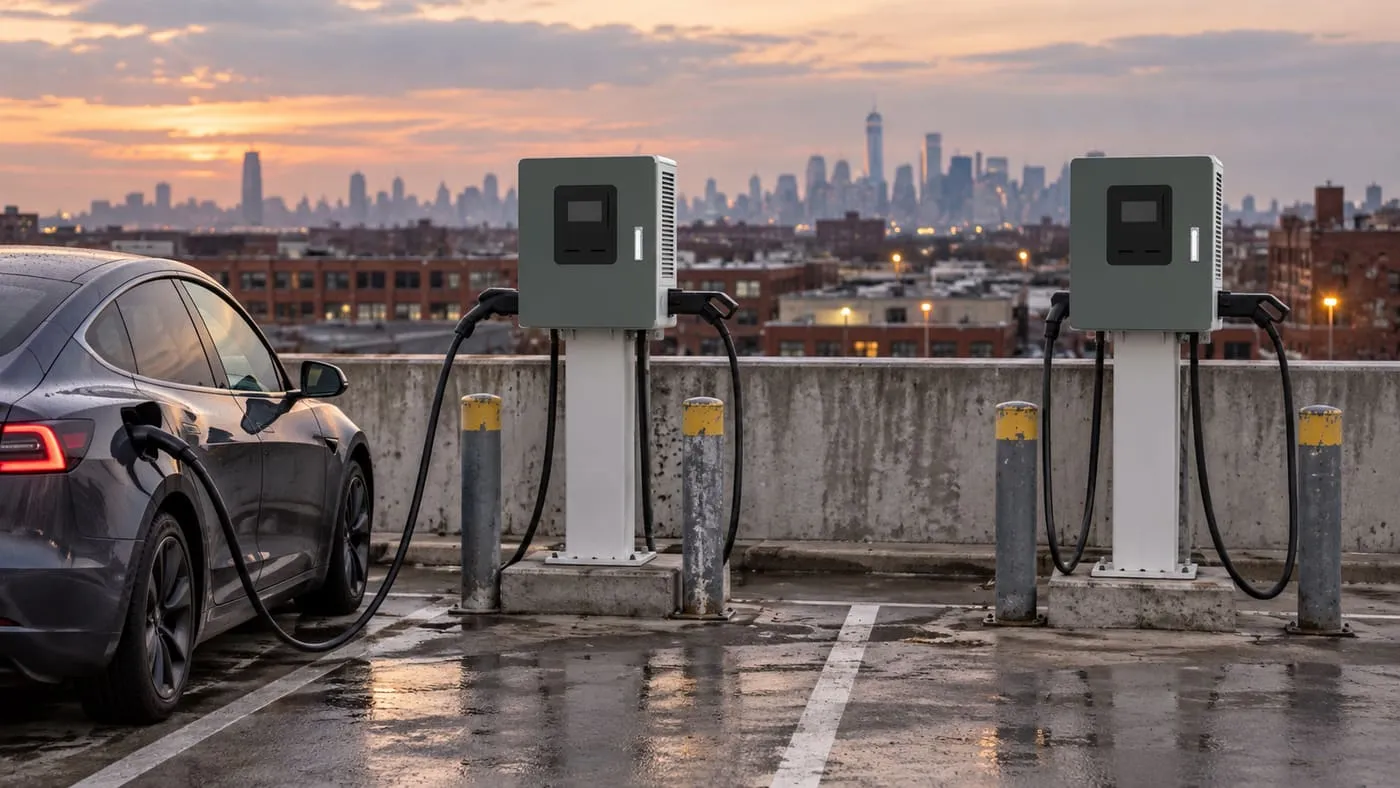
New Jersey sites tend to be small, shared and hemmed in, so the power cabinet matters more than the number of stalls. A strip-mall corner, a parking deck level or a gas station pad may fit four bays and a transformer, not a cabinet farm. Consider a shared power cabinet that splits power dynamically between guns, plan the transformer pad and conduit route before the equipment list, and size the service with the grid capacity calculator. We did not read New Jersey zoning, building-code or demand-charge tariffs, so confirm those with the municipality and the utility. For comparison, see how New York and Massachusetts handle the same dense-site questions.
Model returns in the payback calculator twice: once with the grants you are sure of and once with none.
Matching EVCSTAR units to a New Jersey site
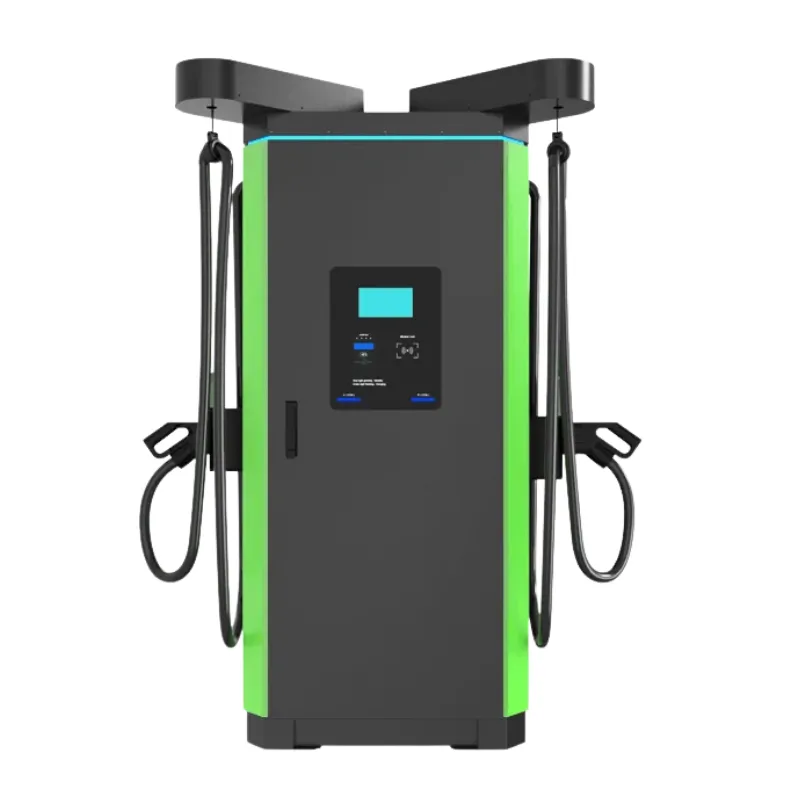
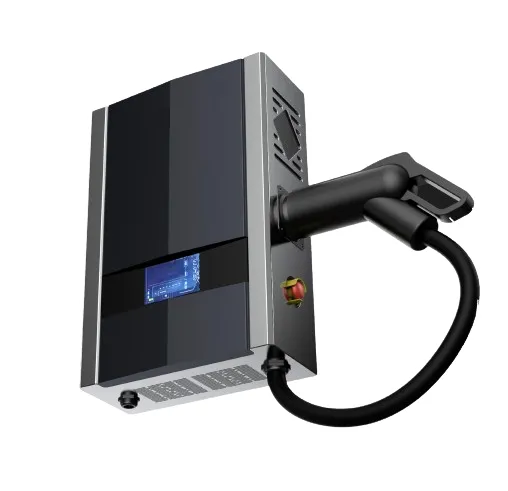
Fit the cabinet to the footprint and the service. The UC series (60-360 kW, 480 V input, CCS1 or NACS) suits corridor and travel-plaza sites; the 360 kW cabinet is a two-gun unit with each CCS gun limited to 200 A, so one car cannot take 360 kW. The SC series (15-30 kW) is the compact wall-mounted DC option for tight sites and small connections. Both support OCPP 1.6J and 2.0.1 and operate up to +55 °C.
Utility and state programmes may have equipment, listing or network requirements that we did not read; we cannot say a model holds a UL or ETL listing, but we can supply technical documents and test reports. Send the utility, service size, number of bays and connector standards through the contact page and we will reply with a configuration and quotation breakdown.
Payback calculator
Example values are filled in — replace them with your own quotation, tariff and traffic figures.
- Energy sold per month
- —
- Net margin per month
- —
- Simple payback
- —
Simple payback = total investment ÷ (energy sold × (price − energy cost) − fixed costs), using 30 days per month. Taxes, financing, subsidies and utilisation growth are not included.
Frequently asked questions
- Can I get PSE&G make-ready funding for a fast-charging site today?
- The programme was approved in January 2021 as a six-year, $166 million make-ready plan with about $45 million for DC fast chargers, and PSE&G says the customer buys the charger. We could not open PSE&G's portal to confirm the current budget, caps or application status, so check the portal before you plan around it.
- Which New Jersey utility will serve my site?
- It depends on the town. PSE&G and JCP&L both run EV programmes, and other utilities serve parts of the state. Ask for a service confirmation by address, because the incentive rules and application route differ by utility.
- Can grants be combined?
- We did not read rules on stacking utility make-ready with the BPU corridor grant, so ask both administrators before you assume it. Many programmes also require approval before purchase or installation.
- What EVCSTAR equipment suits a tight New Jersey site?
- For US sites the UC series (60-360 kW, 480 V, CCS1 or NACS) and the SC series (15-30 kW) have North American builds; SC is the compact wall option. Send the utility, service size, bays and connector choice through the contact page and we will reply with a configuration and quotation breakdown.
References
- [1]New Jersey OKs PSE&G's $166M EV infrastructure program, omits heavy-duty vehicles (28 Jan 2021). Utility Dive.
- [2]JCP&L launches Electric Vehicle Charging Incentive Program (15 July 2022). FirstEnergy / JCP&L.
- [3]EV Tourism Corridor Program (7 May 2025). New Jersey Board of Public Utilities.