Installer guide
NEC Article 625 for Electricians: EV Charger Installation Basics
NEC 625 EV charger installation basics: individual branch circuit, 125% continuous-load sizing, 25 ft cable limit, 60 A disconnect rule and UL 2202.
- Prepared by
- EVCSTAR Engineering Team
- Published
- Reading time
- 4 min
- Sources
- 4 references
At a glance
- Continuous-load sizing
- 125% of load
- Output cable, usable length
- 25 ft max
- Disconnect required above
- 60 A or 150 V to ground
- States on 2023 NEC (Oct 2025)
- 20
Key takeaways
- 1Article 625 treats EV charging as a continuous load: the branch circuit and overcurrent device are sized at 125% of the load, each charging outlet gets its own individual branch circuit, and a disconnect is required above 60 A or 150 V to ground.
- 2Article 625 covers AC systems from 120 V to 1,000 V and DC up to 1,000 V, so 480 V three-phase DC fast-charging equipment is inside its scope; the output cable is limited to 25 ft usable length unless the listed equipment has a cable management system.
- 3UL 2202 is the safety standard for off-board DC charging equipment fed at up to 1,000 V ac or 1,500 V dc; a listing mark from a recognized lab is what an inspector checks, not a brochure.
- 4The edition you work under is set by the state or local authority: as of 1 October 2025, 20 states had adopted the 2023 NEC and the 2026 edition, released in August 2025, had not yet been adopted anywhere.
On this page
Short answer: for NEC Article 625 EV charger installation, size the feeder and overcurrent device at 125% of the charging load, give each charging outlet its own branch circuit, add a lockable disconnect when the equipment is above 60 A or 150 V to ground, and make sure the unit is listed, because the inspector will look at the label before the paperwork.
What Article 625 covers
Article 625 is the NEC’s chapter on EV charging, and it reaches well beyond a home wallbox. It applies to equipment charging on-road vehicles, from cars to buses and trucks, with AC systems at the voltages 120, 120/240, 208Y/120, 240, 480Y/277, 480, 600Y/347, 600 and 1,000 and DC up to 1,000 V, plus the conductors and equipment that connect the vehicle to the supply, by conductive, inductive or wireless means. That scope includes the 480 V three-phase feed a DC fast charger needs. The same article requires the manufacturer to mark equipment “for use with electric vehicles” and requires attachment plugs, vehicle connectors and inlets to be listed or labeled for the purpose. One caution: a trade-press author recommends treating the NEC as a supplement to the installation manual the equipment comes with, and we agree.
Circuits, cables and disconnects
The core rules are short, and each one has a consequence at the panel.
| Item | Rule (as summarised in the sources) |
|---|---|
| Branch circuit | each charging outlet on an individual branch circuit with no other outlets |
| Load type | EV charging is a continuous load; OCPD at not less than 125% of the continuous load |
| Output cable | Type EV, EVJ, EVE, EVJE, EVT or EVJT; usable length not over 25 ft unless the listed equipment has a cable management system |
| Supply cord | for cord-connected units, hard service or junior hard service cord listed for the location |
| Disconnect | readily accessible, lockable in the open position, for equipment above 60 A or above 150 V to ground |
| Load management | where an automatic load management system is used, the system’s permitted maximum sets the load on the service and feeder |
A worked example makes the 125% rule concrete. If a charger’s continuous input is 100 A, the overcurrent device is not less than 125 A. At 480 V three-phase, 100 A is about 83 kVA, which is the figure to give the utility. The automatic load management allowance is worth using on multi-gun sites, since the system’s set limit, not the nameplate sum, can set the service size; the grid capacity calculator shows the trade-off.
Which edition, which inspector
The code you follow is the edition your state or town has adopted, not the newest one. The National Fire Protection Association’s figures, quoted by EC&M, put 20 states on the 2023 NEC as of 1 October 2025, with others on older editions and a few revising their rules. The 2026 NEC came out in August 2025 and no state had begun adopting it when that article was written; its themes include electrification and EV infrastructure. Section numbers shift between editions: the dedicated-circuit rule appears as 625.40 and the GFCI rule for cord-and-plug equipment as 625.54 in 2023 summaries, but references from earlier editions differ. Applying for the permit, scheduling inspection and getting any local amendments is a conversation with the authority having jurisdiction; do it before you order equipment.
UL 2202 in plain terms
UL 2202 is the safety standard for off-board DC chargers, and it is a listing standard, not a performance claim. It covers DC conductive charging equipment supplied at up to 1,000 V ac or 1,500 V dc and recharging the propulsion batteries of on-road vehicles. It is harmonized with CSA C22.2 No. 346 for Canada and NMX-J-817-ANCE for Mexico. Testing covers construction, protection of users from injury and shock, performance tests such as leakage current and abnormal use, production-line dielectric withstand tests and marking. AC charging stations are covered by UL 2594, which the same test laboratory lists separately. For the installer the practical steps are: read the listing mark and certificate for the exact model, check that the ratings on the label match your feeder and environment, and keep a copy for the inspection file. Our standards guide puts these standards beside the European ones.
EVCSTAR equipment on a US job
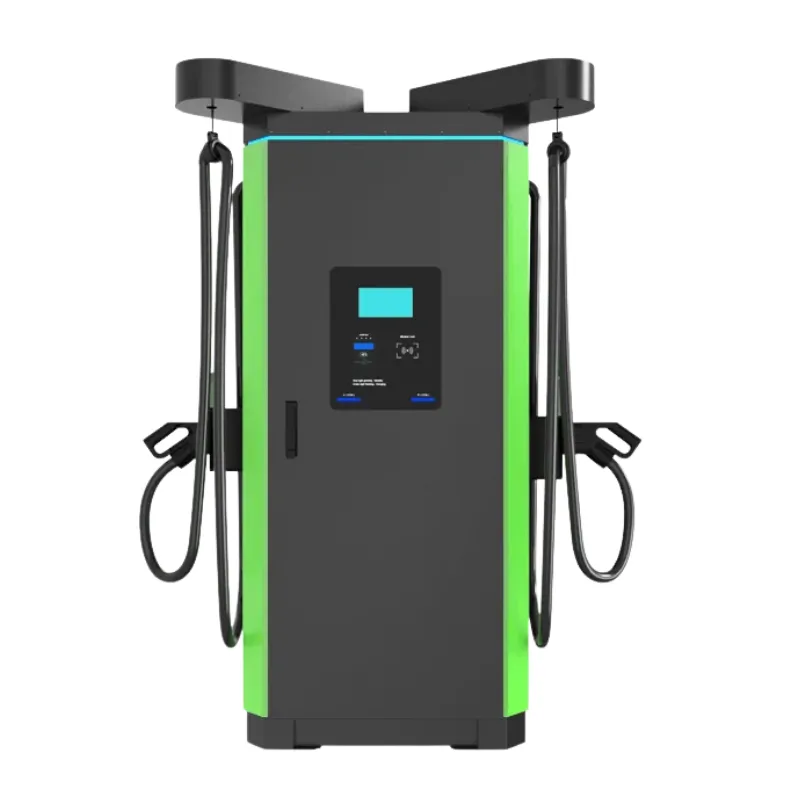
Only the UC series (60-360 kW) and SC series (15-30 kW) have North American builds, with 480 V input and CCS1 or NACS connectors. The UC product page lists UL 2202, UL 2231 and CSA C22.2 No. 280 among the standards for the North American build. We do not state in this guide that any model is listed or certified; whether it is accepted on your job is for your inspector and utility to decide. The 360 kW UC is a two-gun cabinet with up to 200 A per gun, so size the feeder for the cabinet, not for one vehicle.
For a project, send the voltage, number of guns, connector standard, available service capacity and the inspector’s requirements via the contact page. We will reply with a configuration proposal and quotation breakdown, plus the technical documents and test reports we can supply. If you plan to sell under your own name, read what to ask for in white-label chargers as well, and see how a state programme shapes the job in the Texas guide.
Grid capacity calculator
- Spare power for charging
- —
- Input current per charger (400 V)
- —
- Chargers at full power
- —
Spare power = kVA × 0.95 power factor × (1 − margin) − existing peak load. Input current ≈ charger kW ÷ (√3 × 400 V), with power factor and 95 % efficiency added for DC chargers. With dynamic load management more chargers can share the same capacity at reduced power. Always confirm with your electrical engineer and the grid operator.
Frequently asked questions
- Does a DC fast charger need its own branch circuit?
- Yes. The guidance we read says each outlet installed for EV charging is supplied by an individual branch circuit with no other outlets, and 2023-edition summaries place the dedicated-circuit rule at 625.40. Section numbers move between editions, so check the one your inspector enforces.
- Is GFCI protection required on EV chargers?
- For cord-and-plug connected equipment, summaries of the 2023 NEC say a GFCI-protected receptacle is required (625.54). We did not read rules for hardwired equipment in every edition, so follow the manufacturer's instructions and ask the inspector about the local edition.
- Which UL standard covers a DC fast charger?
- UL 2202 covers DC conductive charging equipment supplied at up to 1,000 V ac or 1,500 V dc; it is harmonized with CSA C22.2 No. 346 in Canada. AC equipment falls under a different standard, UL 2594. Ask the manufacturer for the listing certificate for the exact model.
- Can I get EVCSTAR chargers with a UL listing?
- We cannot state that a model holds a UL or ETL listing in this guide. Our North American UC and SC builds list UL 2202 among the standards they are built to. Tell us the project, inspector requirements and utility, and we will send the technical documents and test reports we can supply; confirm what your authority requires before ordering.