Installer guide
UK EV Charger Installer Requirements: Wiring, Approvals and Paperwork
EV charger installer requirements UK: BS 7671 Section 722, Part P notification, OZEV grant approval, the 2021 Smart Charge Point rules and what to hand over.
- Prepared by
- EVCSTAR Engineering Team
- Published
- Reading time
- 5 min
- Sources
- 4 references
At a glance
- Smart regulations in force
- 30 June 2022
- Sales register kept for
- 10 years
- EV circuit RCD rating (max)
- 30 mA
- Open PEN disconnection
- within 5 s above 70 V
Key takeaways
- 1There is no single UK licence for EV charger installers: the legal baseline is BS 7671 (Section 722 for EV supply), notification of the work under Part P in a dwelling in England and Wales, and a charger that meets the Smart Charge Points Regulations 2021 where they apply.
- 2OZEV approval is a condition of the government grant schemes, not a legal licence; the sources we read list competent person scheme membership, public liability insurance, formal EV training and a manufacturer authorisation as the evidence.
- 3The Smart Charge Points Regulations came into force on 30 June 2022 and cover non-public, non-rapid chargers for cars and vans; the seller must supply a signed statement of compliance and keep a sales register for ten years.
- 4A trade-press guide reports that BS 7671:2018+A4:2026 became available in April 2026 and replaces the earlier text on 15 October 2026, so certificates issued after that date should cite it; confirm with your scheme provider.
On this page
Short answer: the EV charger installer requirements in the UK are a mix of wiring rules, paperwork and product rules rather than one licence: wire to BS 7671 Section 722, notify domestic work under Part P through a competent person scheme or building control, hand over a charger that meets the Smart Charge Points Regulations where they apply, and add OZEV approval only if you want to claim grants for customers.
The wiring standard and which edition
BS 7671 is the standard the inspector tests against, and Section 722 is its chapter for EV supply equipment. A trade guide from Reonic (September 2026) reports that Amendment 4, published as BS 7671:2018+A4:2026 in April 2026, replaces the previous text on 15 October 2026 and that Section 722 carries forward from Amendment 2. We read that on a vendor blog citing NICEIC, not on the IET site, so check the date with your certification scheme before the first certificate you issue after the changeover.
The same guide summarises the points that fail inspections most often:
| Topic | What the guide reports |
|---|---|
| Circuit | one dedicated final circuit per charge point |
| RCD | own RCD, 30 mA maximum, disconnecting all live conductors (a single-pole RCBO does not qualify) |
| DC fault current | Type B RCD, or Type A / F with a 6 mA RDC-DD, unless the charger has it built in |
| PME (TN-C-S) supply, outdoor point | open PEN protection: disconnect within 5 seconds if the earth voltage exceeds 70 V, or an earth electrode, or equivalent built into the charger |
| Certificate | Electrical Installation Certificate for a new circuit; cite the edition in force on the date |
Regulation numbers differ between trade sources, so quote them from the standard itself, not from a blog.
Notification and sign-off in a dwelling
In a house or flat in England and Wales, a new charge point is notifiable work. LABC Front Door gives the reason: a new charge point means a new electrical circuit, and electrical work in a dwelling is controlled under Part P. You have two routes. The first is membership of a recognised competent person scheme such as NAPIT or NICEIC, which lets you self-certify and issue a Building Regulations compliance certificate. The second is a building notice or full plans application to the local building control body before work starts. Non-dwelling buildings sit outside Part P, but the Electricity at Work Regulations still apply, so a commercial car park still needs a competent, certified installation. Scotland and Northern Ireland run their own building regulations, and LABC’s note covers England and Wales only; confirm the local route there.
OZEV approval is for grants, not for permission
OZEV approval is a grant-scheme condition, and the evidence list is short. Elec Training (November 2025) lists four items: proof of membership of a government-approved competent person scheme, public liability insurance, formal EV installation training (it names the C&G 2921-31 qualification as an example), and authorisation by at least one recognised charge point manufacturer. Once verified, the business appears on the list of approved installers and can claim on behalf of eligible customers. We have not read the current official scheme rules in full, so the grant amounts and eligible customers are not stated here; a customer should not assume a grant exists until the installer has checked.
The Smart Charge Points Regulations and the paperwork
The regulations put the duty on the seller, but the installer is often the seller, so read them. The Electric Vehicles (Smart Charge Points) Regulations 2021 came into force on 30 June 2022 and extend to England, Wales and Scotland. They apply to charge points for cars and vans other than non-smart cables, public charge points and rapid charge points (50 kW or more). A person must not sell, or offer for sale, a covered charge point unless it meets the functional requirements (smart functionality, off-peak charging, randomised delay, security and others) and the paperwork duties are met. Those duties are:
- a signed, dated statement of compliance identifying the model and giving the seller’s name and address;
- a technical file, which the buyer can ask for, with the design, manual and relevant test reports;
- a register of every covered charge point sold in the past ten years.
For the customer handover, add the Electrical Installation Certificate, the Part P compliance certificate where it applies, the charger’s manual and commissioning record, and the load-management settings you configured.
What to ask a charger supplier for
Ask for documents before you order, because the installer carries the risk if they are missing.
| Ask for | Why it matters |
|---|---|
| Statement of compliance and technical file | needed to sell a covered unit in Great Britain |
| Integral DC fault detection and PEN fault protection data | decides whether you need a Type B RCD or extra devices |
| Test reports for the exact model | evidence for your own file |
| Input current and recommended protection | circuit and cable design |
| Load-management and OCPP details | settings you will certify |
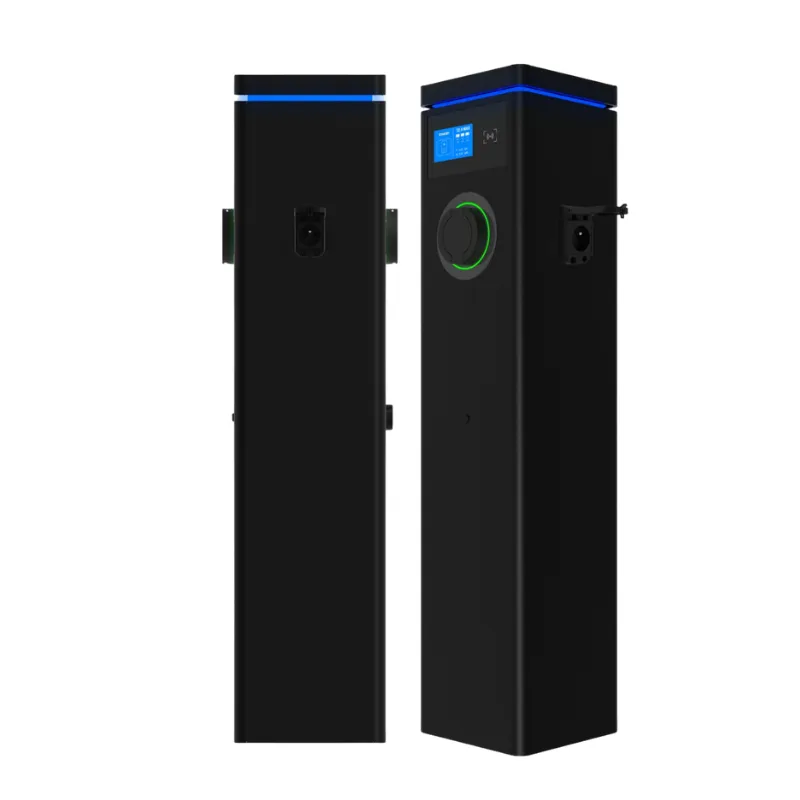
EVCSTAR chargers on a UK job
For homes, workplaces and private car parks the relevant EVCSTAR units are the FE series and the dual-point CPO series. Both are Type 2, 3.7 to 22 kW, list a 30 mA Type A RCD with 6 mA DC leakage detection, offer a PEN fault protection option for the UK, and carry OCPP 1.6J / 2.0.1 communication; the product pages list CE and UKCA among the standards. We do not state here that any model satisfies the Smart Charge Points Regulations or is on a grant list; those are matters for the specific model and the seller’s declaration. We can supply technical documents and test reports to support your file.
Send us the supply type (single or three phase, PME or TT), the number of points and the site’s load limit through the contact page, and we will reply with a configuration proposal and quotation breakdown. For market context see the United Kingdom guide, and for how installer firms organise the business side read the installer business guide.
Frequently asked questions
- Do I need to be OZEV approved to install an EV charger in the UK?
- Not to install one. Approval matters when you want to claim a government grant for a customer: the guide we read says you apply first and supply proof of competent person scheme membership, public liability insurance, formal EV charging training and authorisation from at least one charge point manufacturer. Grant rules change, so check the current official installer guidance.
- Is a home EV charger installation notifiable?
- In a dwelling in England and Wales, yes. LABC Front Door says a new EV charge point adds a new circuit, so the work is notifiable under Part P: either use an installer in a competent person scheme who issues a compliance certificate, or submit a building notice or full plans application. Non-domestic buildings are outside Part P but covered by the Electricity at Work Regulations.
- Do the Smart Charge Points Regulations apply to a 50 kW DC charger?
- No. Regulation 3 excludes public charge points and rapid charge points, defined as 50 kW or more, as well as non-smart cables. A 22 kW workplace or home unit is inside the rules; a public rapid unit is not.
- Which RCD protection does an EV circuit need?
- The guide we read says each charge point has its own RCD of no more than 30 mA that disconnects all live conductors, plus protection against smooth DC fault current: a Type B RCD, or Type A or F with a 6 mA RDC-DD unless the charger provides it. Check the manufacturer data and the edition of BS 7671 you certify to.
References
- [1]The Electric Vehicles (Smart Charge Points) Regulations 2021, regulations 1, 3, 4, 8, 13 and 14. legislation.gov.uk (UK Government).
- [2]Do I need to make a building regulations application for an electric vehicle charging point?. LABC Front Door.
- [3]EV Charger Installation Regulations UK: The 2026 Installer's Compliance Guide (15 September 2026). Reonic.
- [4]How to Become an OZEV Authorised Installer (12 November 2025). Elec Training.