Cost guide
EV Charger Installation Cost per Bay: How It Falls as You Add Bays
EV charging station installation cost per bay falls about 61% from 1 to 6+ chargers (150 kW, ICCT 2019: $47,781 to $18,577). Shared infrastructure explained.
- Prepared by
- EVCSTAR Engineering Team
- Published
- Reading time
- 4 min
- Sources
- 3 references
At a glance
- 150 kW install per charger, 1-charger site (ICCT, 2019 $)
- $47,781
- 150 kW install per charger, 6-20 charger site (ICCT, 2019 $)
- $18,577
- 350 kW install per charger, 1 vs 6-10 per site (ICCT, 2019 $)
- $65,984 vs $25,654
- DC fast installation per connector today (AFDC)
- $20,000-$60,000
Key takeaways
- 1EV charging station installation cost per bay drops steeply with site size: ICCT (2019 dollars) puts installation of a 150 kW charger at $47,781 for a one-charger site, $38,047 each for two, $28,312 each for 3-5 and $18,577 each for 6-20, a 61% fall from one to six or more.
- 2Power matters less than count: in the same study a 350 kW charger costs about $18,000 more to install than a 50 kW one at a single-charger site ($65,984 against $45,506), because labour, permits and trenching are shared across more output.
- 3The saving comes from sharing trenches, switchgear, transformer and permits, but only until a step in the grid connection; the study cites about 2.5 MW as a site limit before costs jump, and UK Cenex data show connection bands from under 3,000 to over 2 million pounds as capacity grows.
- 4AFDC, the US Department of Energy's data centre, also reports per-charger cost falling significantly for larger installations and labour as the largest installation expense; use the grid capacity calculator to find where your next step lies.
On this page
Short answer: EV charging station installation cost per bay is highest on a one-bay site and falls steeply as bays are added, because trenching, switchgear, permits and the grid connection are shared; in the best-documented public dataset, installation per 150 kW charger fell by 61% between a one-charger and a six-plus-charger site.
What the cost per bay is made of
Installation per bay has a per-site part and a per-bay part, and the per-site part is divided by your bay count. The AFDC lists labour as the largest installation expense and says the per-charger cost drops significantly on larger installations. The table separates what is shared from what is not.
| Cost item | Scales with | Shared across bays? |
|---|---|---|
| Trenching, ducts, cable route | Distance | Mostly yes |
| Transformer, switchgear, metering | Site power | Yes, until a capacity step |
| Permits, design, mobilisation | Per project | Yes |
| Protection, local cabling, pad | Per bay | No |
| Signage, bay markings, barriers | Per bay | No (Cenex lists road markings at 75-150 pounds and barriers at 200-300 pounds per bay) |
| Charger hardware | Per bay and power | No |
See the total build cost breakdown for how these add to the full project.
How installation cost falls with site size
ICCT’s Table 4 gives the clearest published scaling: every extra tier of site size cuts the per-charger installation cost by roughly a fifth to a third. The figures are 2019 US dollars including labour, materials, permits and taxes, and “charger” means a unit of the stated power; ICCT counts a charger by its power rating rather than by the number of outlets.
| Installation per charger, 2019 USD | 1 per site | 2 per site | 3-5 per site | 6+ per site |
|---|---|---|---|---|
| 50 kW (up to 50 per site) | $45,506 | $36,235 | $26,964 | $17,692 |
| 150 kW (up to 20 per site) | $47,781 | $38,047 | $28,312 | $18,577 |
| 350 kW (up to 10 per site) | $65,984 | $52,541 | $39,097 | $25,654 |
Two readings matter. First, the jump from 50 to 350 kW adds only about $20,000 at a one-charger site, so power is a smaller driver than count; ICCT says higher power does raise the chance that switchgear and distribution lines need upgrading, and that this is highly variable. Second, the figures exclude signage, striping, lighting and security cameras. They are also old: use the percentages, not the dollars, and compare with AFDC’s current $20,000-$60,000 per connector for installation.
Worked example: 1, 2, 4 and 8 bays of 150 kW
On the ICCT ratios, eight bays cost about three times as much to install as one, not eight times. The example applies the 150 kW row in 2019 dollars. It assumes each bay is a separate 150 kW charger, that four chargers fall in the 3-5 tier and eight in the 6-20 tier, and that no grid step is crossed.
| Chargers on site | Installation per charger | Site installation total | Versus one charger |
|---|---|---|---|
| 1 | $47,781 | $47,781 | baseline |
| 2 | $38,047 | $76,094 | 20% lower per charger |
| 4 | $28,312 | $113,248 | 41% lower per charger |
| 8 | $18,577 | $148,616 | 61% lower per charger |
Put your own bay count, grid cost and sessions in the payback calculator: a cheaper bay only helps if the extra bays are used.
Where the saving stops
The saving ends at the next grid step, so check capacity before you add bays. ICCT mentions a site limit of about 2.5 MW before costs change in steps. Cenex’s UK bands show the same pattern in grid connection alone: 1,000-3,000 pounds up to 70 kVA, 4,500-75,000 pounds for 200-1,000 kVA, and 60,000 pounds to 2 million above 1,000 kVA, with only a rough link to charger counts. If your fourth bay needs a new transformer, the real cost of that bay includes it. Our transformer cost page and the grid capacity calculator show where your steps are.
How to design for a lower cost per bay
Build the shared parts for the final size and fill the bays in phases.
- Lay ducts and the main feeder for the planned end state; adding conduit later is the expensive part.
- Place bays close together and close to the transformer to cut cable and trench length.
- Use power sharing across bays so the connection is sized for realistic simultaneous load, not the sum of nameplates.
- Ask the utility for a capacity quote for both the first phase and the full build.
- Bundle phases under one permit where the authority allows.
What this means for choosing EVCSTAR equipment
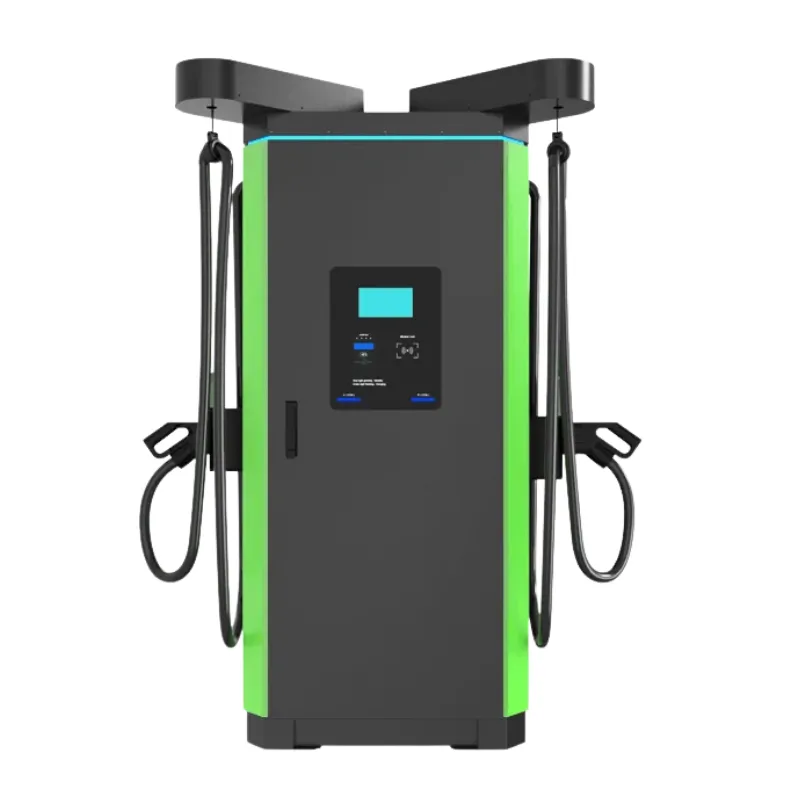
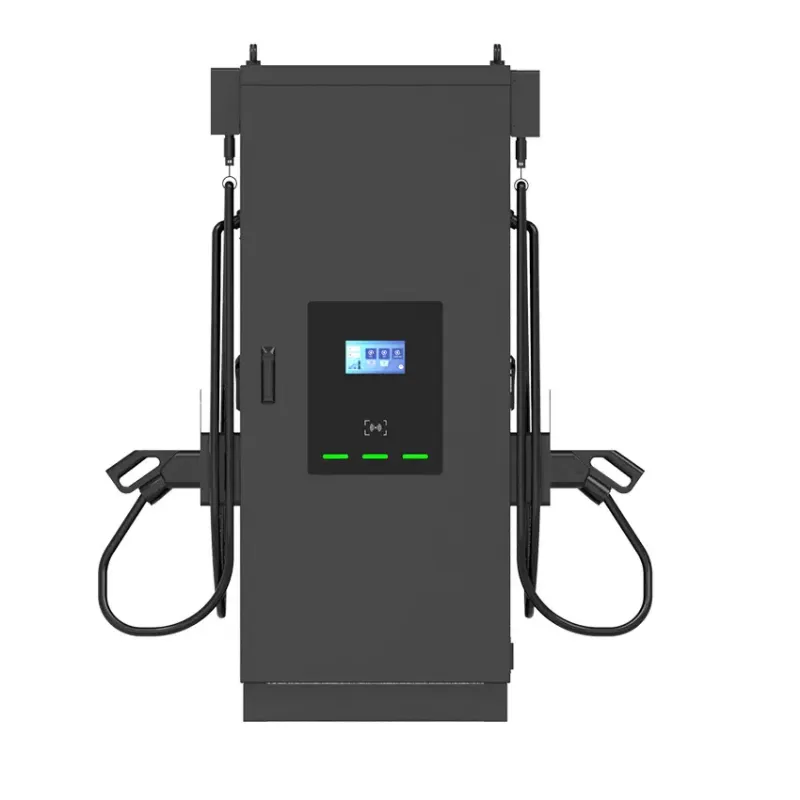
Equipment price per bay is a separate block that depends on configuration, so scale the install figures above and the hardware separately. For multi-bay sites, the UC series puts two guns on one cabinet with dynamic power sharing, which affects how many power units and feeders you need; the CC series suits tighter footprints and the HC series small yards. All support OCPP 1.6J and 2.0.1 and operate up to +55 °C. Send us your bay count, supply voltage, available kVA and connector standard through the contact page, and we will return a configuration plan and a quotation breakdown that shows cabinet and cable choices against your connection.
Payback calculator
Example values are filled in — replace them with your own quotation, tariff and traffic figures.
- Energy sold per month
- —
- Net margin per month
- —
- Simple payback
- —
Simple payback = total investment ÷ (energy sold × (price − energy cost) − fixed costs), using 30 days per month. Taxes, financing, subsidies and utilisation growth are not included.
Grid capacity calculator
- Spare power for charging
- —
- Input current per charger (400 V)
- —
- Chargers at full power
- —
Spare power = kVA × 0.95 power factor × (1 − margin) − existing peak load. Input current ≈ charger kW ÷ (√3 × 400 V), with power factor and 95 % efficiency added for DC chargers. With dynamic load management more chargers can share the same capacity at reduced power. Always confirm with your electrical engineer and the grid operator.
Frequently asked questions
- How much does it cost to install one EV charging bay?
- It depends mainly on how many bays share the site. For a 150 kW DC charger, ICCT (2019 dollars) estimated installation at $47,781 at a one-charger site and $18,577 per charger at a site with 6-20. A current figure is higher or lower depending on labour, materials and the grid connection, so treat them as ratios. AFDC currently cites $20,000-$60,000 per DC fast connector for installation, excluding the equipment.
- Why is each additional bay cheaper?
- Because several costs are paid once per site: the trench and cable route, the transformer or switchgear, permits, design and mobilisation. Adding a bay on a prepared site adds a charger, a short cable run and a protection device. ICCT notes that costs do not rise in proportion to power, so installation is mainly a function of the number of chargers per site.
- When does adding bays stop being cheap?
- When you cross a grid step. A new transformer, a medium-voltage connection or a substation upgrade adds a lump sum. ICCT cites a site limit of about 2.5 MW before a step change in costs, and Cenex shows UK connection bands for 200-1,000 kVA of 4,500-75,000 pounds, rising to 60,000 pounds-2 million above 1,000 kVA. Ask the utility early.
- Does power sharing reduce the cost per bay?
- It can, because a cabinet with dynamic power sharing serves two guns from one power unit and may fit a smaller connection. The saving depends on how many cars charge at once and on utility rules. Use the grid capacity calculator to test your numbers; we do not quote a fixed percentage.
References
- [1]Estimating electric vehicle charging infrastructure costs across major U.S. metropolitan areas (Working Paper 2019-14, Table 4). International Council on Clean Transportation (August 2019).
- [2]Infrastructure Development for Electric Vehicle Charging (costs per connector). U.S. Department of Energy, Alternative Fuels Data Center.
- [3]Costs (BETT guidance): hardware, installation items and grid connection bands. Cenex.