Price guide
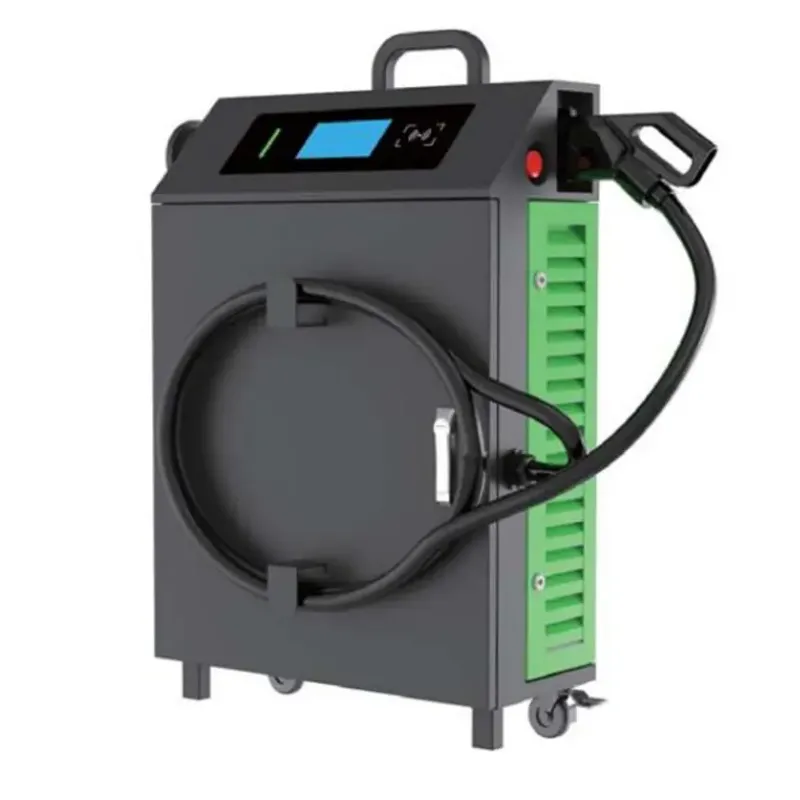
Mobile DC Charger (MC Series): Price Factors and Use Cases
Mobile EV charger price factors for a battery-less 20–80 kW DC unit: power, supply current, cable and connectivity options, and where it beats a fixed charger.
- Prepared by
- EVCSTAR Engineering Team
- Published
- Reading time
- 4 min
- Sources
- 3 references
At a glance
- MC series output range
- 20–80 kW
- Input current, MC20 to MC80
- 31 A to 124 A per phase
- Output voltage
- 200–1000 V DC, CCS2
- Florida mobile units, 2024
- 50 kW, up to 11 sites
Key takeaways
- 1A mobile EV charger price depends first on output power: our MC series runs 20, 30, 40, 60 or 80 kW (MC20–MC80), and the supply it plugs into must carry 31 A to 124 A per phase.
- 2The MC series has no battery. It is a wheeled DC charger that draws from a three-phase outlet, so a mobile unit saves the trenching and mounting of a fixed charger but not the electrical supply.
- 3For a fixed public DC connector the U.S. Department of Energy quotes $38,000–$90,000 for equipment and $20,000–$60,000 for installation; a mobile unit skips part of the second figure, but those are fixed-charger numbers, not a mobile price.
- 4Real mobile deployments are modest in power: the RAC fitted its roadside vans with 3.5 kW to 5 kW chargers, while Florida put 50 kW mobile units on I-75 for the 2024 hurricane evacuation.
On this page
Short answer: a mobile EV charger price depends mostly on output power and on the electrical supply it must run from, because a battery-less unit like our MC series (20–80 kW) saves the trenching and mounting of a fixed charger but still needs a three-phase outlet sized for it; the useful comparison is the whole cost of getting charge to the vehicle, not the unit price alone.
What sets the price of a mobile DC charger
Power rating comes first, then everything the unit plugs into. Each MC unit is configured to your needs, so send us your supply and vehicle details through the contact page and we will return a configured quotation. These are the factors that move a quote:
| Factor | Why it matters | What to decide |
|---|---|---|
| Output power (20–80 kW) | More power modules, larger conversion stage | Choose the highest your supply can carry |
| Input cable and plug | Cable length and plug type must match your outlets | Custom input cable and plug is an option |
| Connectivity | Ethernet is standard; 4G and Wi-Fi are optional | Fleet use usually wants 4G |
| Branding | OEM branding is an option | Only for resellers and large fleets |
| Quantity and spares | Affects unit pricing and your downtime | Confirmed per project |
For scale only: the U.S. Department of Energy’s AFDC quotes public DC fast charging at $38,000–$90,000 for equipment and $20,000–$60,000 for installation per connector (US figures, source year not stated on the page), with labour the largest installation cost. A mobile unit avoids part of the installation, but we found no neutral public price for battery-less mobile DC chargers, so do not infer one from those figures.
Pick the model by the supply you have
A mobile DC charger is limited by the outlet, not by the car. From the MC series specification, input current per phase and maximum output current are:
| Model | Max. output power | Input current per phase | Max. output current |
|---|---|---|---|
| MC20 | 20 kW | 31 A | 66.5 A |
| MC30 | 30 kW | 47 A | 100 A |
| MC40 | 40 kW | 62 A | 133 A |
| MC60 | 60 kW | 93 A | 200 A |
| MC80 | 80 kW | 124 A | 250 A |
At the 400 V three-phase input of the MC series, 31 A is roughly 21 kVA and 124 A roughly 86 kVA (our calculation: √3 × 400 V × current). Many workshops and yards have a distribution board for the lower models and not the upper ones, so what you spend on the electrical side can exceed the difference between two models. Ask your electrician and the utility before you choose, and use the grid capacity calculator for the load.
Where a mobile unit earns its place
Use a mobile charger when the vehicles move and the demand is uneven. The pattern from public deployments is short, flexible charging, not a permanent bay.
- Roadside rescue. The RAC (UK) planned to equip about one in every five patrol vans (200 by end of 2021 and 120 more in 2022) with a van-mounted 3.5 kW charger, upgraded to 5 kW, to give a stranded car enough charge to reach a nearby charge point (RAC press release, 2021). A wheeled 20–80 kW unit is a different class: it needs a three-phase supply, not a generator on a van.
- Evacuations and emergencies. In October 2024 Florida put up to ten temporary 50 kW single-port mobile chargers on the I-75 corridor and one near I-4 for Hurricane Milton, at park-and-ride lots and a travel centre (Joint Office, 2024).
- Workshops, dealers and fleet yards. One charger rolled to the bay that needs it replaces several fixed ones that stand idle.
- Events and temporary sites. Charging for a weekend does not justify digging, if the venue has the supply.
When a fixed charger is the better buy
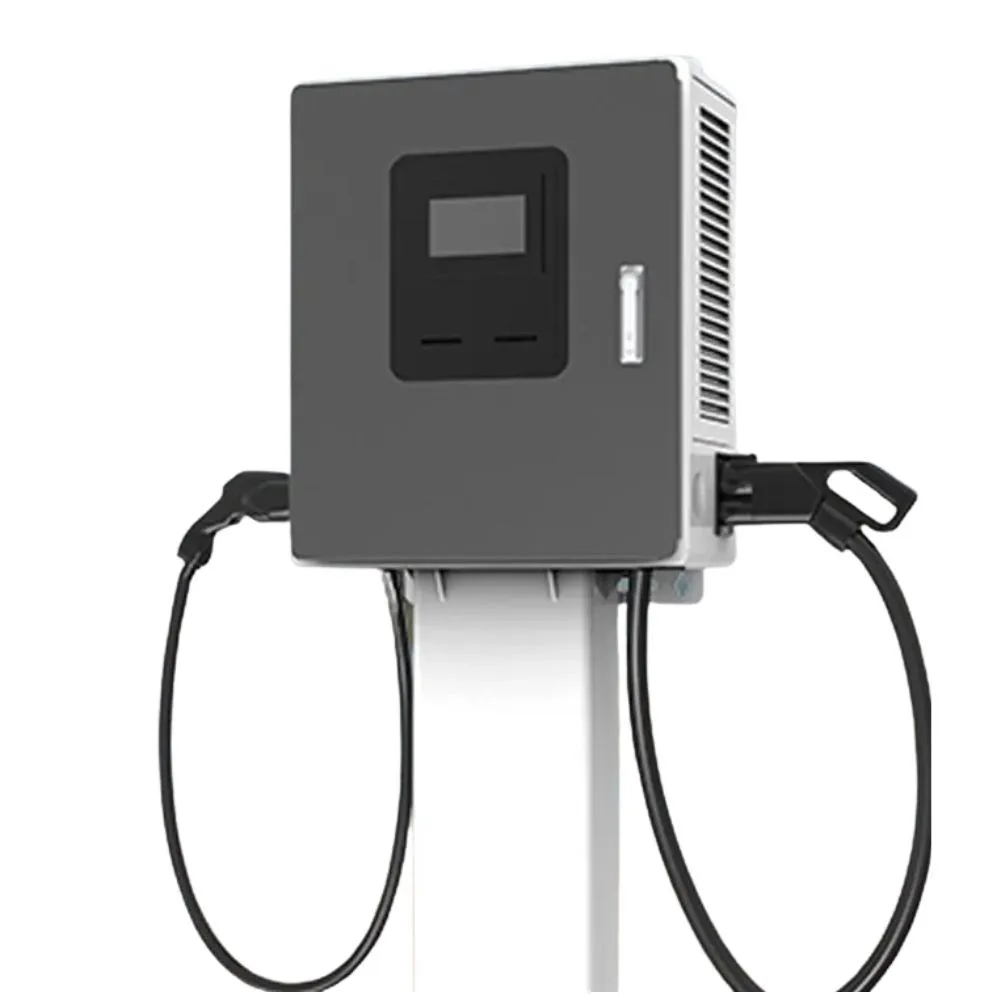
If the same bay is used every day, a fixed charger wins. Fixed units are mounted, weather-protected and often cheaper per kW of daily throughput. Mobile units suit sites that are short on bays or time. Our total cost breakdown and the transformer cost page show which lines a mobile unit can and cannot remove: it avoids trenching and mounting, but not a transformer that is too small.
How EVCSTAR equipment fits
The MC series is the mobile DC unit, 20–80 kW, CCS2, 200–1000 V DC output, with a 7-inch touch display, RFID and QR authentication, OCPP 1.6J and 2.0.1, and operation up to +55 °C. It has no battery and is not a permanent installation. For fixed bays at the same site choose the HC series. Tell us the supply available (voltage, current, plug) and the vehicles, and we will recommend a model and issue a written quotation; dimensions, weight and terms are confirmed per order. The standard warranty is 12 months (see warranty).
Grid capacity calculator
- Spare power for charging
- —
- Input current per charger (400 V)
- —
- Chargers at full power
- —
Spare power = kVA × 0.95 power factor × (1 − margin) − existing peak load. Input current ≈ charger kW ÷ (√3 × 400 V), with power factor and 95 % efficiency added for DC chargers. With dynamic load management more chargers can share the same capacity at reduced power. Always confirm with your electrical engineer and the grid operator.
Frequently asked questions
- How much does a mobile EV charger cost?
- The MC series price depends on your configuration, so send us your site data through the contact page and we will return a configured quotation. The main drivers are output power (20–80 kW), the length and type of input cable and plug, optional 4G or Wi-Fi, branding, and the order quantity. For scale only, a fixed DC connector is quoted by the US Department of Energy at $38,000–$90,000 for equipment plus $20,000–$60,000 for installation; that is not a mobile price.
- Does a mobile DC charger have a battery inside?
- The MC series does not. It runs from a three-phase supply and cannot deliver more than the supply gives it, which is why the choice of model starts with the outlet. A battery-based mobile unit is a different product with a different cost structure, and we do not offer one in this range.
- Which model suits a dealer workshop?
- Usually the 30 kW or 40 kW model, which needs about 47 A or 62 A per phase and charges cars fast enough for handover or diagnostics. Check the actual supply and the site electrician first: use the grid capacity calculator or send us the available current and we will help match the model.
- Can I use it as a permanent charger instead of a wallbox?
- It is designed for moving and to be stored under cover between uses, not for permanent outdoor mounting. For fixed bays, a wall-mounted or floor-standing DC charger is the better fit.
References
- [1]Infrastructure Development for Electric Vehicle Charging (cost considerations). U.S. Department of Energy, Alternative Fuels Data Center.
- [2]RAC exclusive deal will see hundreds more mobile EV charging vans on the road (28 May 2021). RAC.
- [3]Florida mobile charging for Hurricane Milton evacuation (8 October 2024). Joint Office of Energy and Transportation.