Cost guide
360 kW Ultra-Fast Charger Cost and Grid Requirement
360 kW EV charger cost: hardware near US$120,000–150,000+ (2025), 387 kVA at 480 V per cabinet, and whether cars can use that power. Worked sums with sources.
- Prepared by
- EVCSTAR Engineering Team
- Published
- Reading time
- 4 min
- Sources
- 8 references
At a glance
- 350 kW hardware (utility program, May 2025)
- About US$120,000–150,000+
- UC360N input at 480 V
- 465 A per phase, about 387 kVA
- Average peak charge rate, 2026 models (Recurrent)
- 214 kW
- Host cost per kWh at 300 kW, high use (NASEO, 2021)
- About US$0.35
Key takeaways
- 1Hardware gets cheaper per kW as power rises: a utility program document gives about US$120,000–150,000+ for 350 kW against US$75,000–100,000+ for 150 kW (May 2025), which is roughly US$340–430 per kW against US$500–670.
- 2A 360 kW North American cabinet draws 465 A per phase at 480 V, about 387 kVA, so one cabinet fills the 200–1,000 kVA connection band and a third pushes a site past 1,000 kVA.
- 3Cars rarely use the headline number. Recurrent put the 2026 average peak charge rate at 214 kW (February 2026), and ArenaEV found mean 0–80% power plateauing near 180 kW across tested cars (2022).
- 4NASEO modelled the same energy at three power classes: in its high-use case the host paid about US$0.12 per kWh at 50 kW, US$0.21 at 150 kW and US$0.35 at 300 kW (2021 tariffs), because the demand charge follows the peak, not the sales.
On this page
Short answer: a 360 kW EV charger costs about US$120,000–150,000+ in hardware if the 350 kW class range of a 2025 utility program document is a fair guide, and then it asks the site for roughly 387 kVA at 480 V. The cabinet is the smaller question. The larger ones are whether the connection exists, whether your cars can use the power, and what a 360 kW peak does to the monthly bill.
Hardware: more kW per dollar, but only on paper
Capital cost per kW falls as power rises. The Tucson Electric Power program document lists approximate hardware ranges by class (May 2025). The per-kW figures are our division:
| Class | Hardware range | Per kW |
|---|---|---|
| 50 kW | US$20,000–30,000+ | US$400–600 |
| 150 kW | US$75,000–100,000+ | US$500–670 |
| 350 kW | US$120,000–150,000+ | US$340–430 |
The document says these are approximations and that installation, permits, software, and front-of-meter and behind-the-meter upgrades are extra. Treat the “+” as a floor.
What 360 kW asks of the supply
One UC360N cabinet draws about 387 kVA. The spec sheet gives 465 A per phase at 480 V, so 1.732 × 480 × 465 = 386,600 VA. Output 360 kW divided by the 95.2% full-load efficiency is about 378 kW of input.
| Site | Input current | Load | Comment |
|---|---|---|---|
| 1 × UC360N | 465 A | about 387 kVA | Feeder and breaker at 125%: about 581 A |
| 2 × UC360N | 930 A | about 773 kVA | Still under 1,000 kVA |
| 3 × UC360N | 1,395 A | about 1,160 kVA | Past 1,000 kVA, the top Cenex band |
EC&M (2023) notes that EV charging loads are continuous loads and that overcurrent protection for feeders and branch circuits must be at least 125% of the load. GreenLancer, a US installer, adds that high-power sites may need medium-voltage service. In the UK, Cenex shows the pattern: 200–1,000 kVA connections cost £4,500–75,000 and take 8–12 weeks, while above 1,000 kVA the range is £60,000 to £2 million and 6 months or more. US cost rules differ, so ask your utility for its own schedule; the transformer guide covers ownership.
Will vehicles use 360 kW?
Usually not for long, and not all at once. Recurrent’s February 2026 ranking lists an average peak charge rate of 214 kW for 2026 models, with the Lucid Gravity at 400 kW and the Hyundai Ioniq 5 listed at 350 kW but capped near 235–240 kW in testing. Peaks are brief: ArenaEV’s 2022 comparison found mean 0–80% power of 175 kW for a Lucid Air that peaks at 300 kW, and 147 kW for a Porsche Taycan peaking at 270 kW.
A connector’s power is voltage times current, so what one car receives depends on its pack voltage and the connector’s current rating. The UC360N is a two-gun cabinet, so 360 kW is a pool the guns share. The product page lists CCS output current of 0–200 A; ask for the per-gun power curve at 400 V and 800 V for the exact build and cable.
What the peak does to the bill
NASEO’s same-energy comparison shows the cost of a higher peak. In its 2021 study of 73 Intermountain West service classes, a station sold 10,800 kWh a month (high use) or 1,080 kWh (medium) at three peak sizes. Average host cost per kWh:
| Use | 50 kW | 150 kW | 300 kW | Demand share at 300 kW |
|---|---|---|---|---|
| High (10,800 kWh) | US$0.12 | US$0.21 | US$0.35 | 74.3% |
| Medium (1,080 kWh) | US$0.60 | US$1.54 | US$2.92 | 89.5% |
At NASEO’s average of about US$10 per kW, a 360 kW peak is US$3,600 a month before any energy is sold. Capping the cabinet below nameplate lowers that line; see demand charges.
Is 360 kW a NEVI requirement?
No. 23 CFR 680.106 asks for at least four ports, each able to deliver up to 150 kW at the same moment, with power sharing allowed. Two 300 kW cabinets (UC300N: 388 A, about 323 kVA each, 645 kVA together) cover four such ports. Choose 360 kW only if your vehicle mix, growth plan and tariff justify the larger peak. The same rule requires certification by a nationally recognized testing laboratory, so confirm the listing of the exact configuration.
How this relates to EVCSTAR equipment
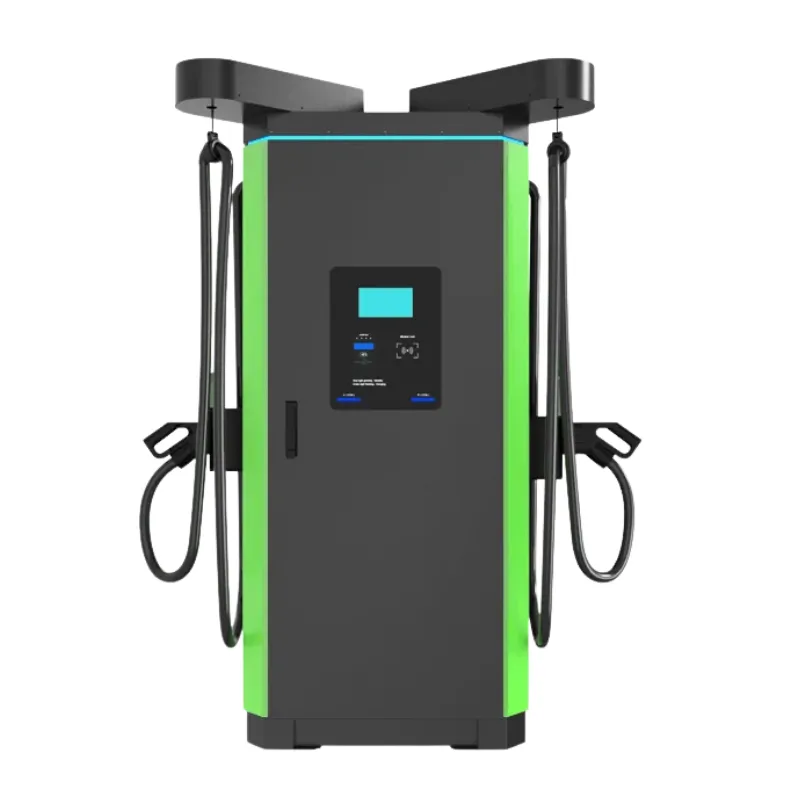
The 360 kW point belongs to the North American build of the UC Series. The UC Series is a floor-standing, two-gun cabinet: European build 60–300 kW at 400 V, North American build 60–360 kW at 480 V, with 465 A per phase at the top. Price depends on power, cable and connector set, options and site conditions, so send the utility’s load data, your vehicle mix, voltage, number of bays and connector standard through the contact page and we will return a configured quotation. To size a site, use the grid capacity calculator first. A step down to the UC300N (388 A) or UC240N (310 A) shrinks the connection request; see also the 180 kW cost guide for the lower class.
Grid capacity calculator
- Spare power for charging
- —
- Input current per charger (400 V)
- —
- Chargers at full power
- —
Spare power = kVA × 0.95 power factor × (1 − margin) − existing peak load. Input current ≈ charger kW ÷ (√3 × 400 V), with power factor and 95 % efficiency added for DC chargers. With dynamic load management more chargers can share the same capacity at reduced power. Always confirm with your electrical engineer and the grid operator.
Frequently asked questions
- How much does a 360 kW EV charger cost?
- A utility program document puts 350 kW charger hardware at about US$120,000–150,000+ (May 2025), before installation, grid work and civil costs. Our other cost pages show that those lines can exceed the hardware. The price depends on your configuration, so send us your voltage, connector and cable options and we will return a configured quotation.
- What electrical supply does a 360 kW charger need?
- The UC360N lists 465 A per phase at 480 V three-phase, about 387 kVA. Protective devices and feeders for continuous EV loads are normally sized at 125% of that current in the US, about 581 A, so the actual breaker and cable are larger. Your electrician and utility confirm the final figures.
- Will my customers' cars actually charge at 360 kW?
- Most will not. Recurrent lists a 214 kW average peak for 2026 models, and a few vehicles peak above 300 kW only for part of a session. Check your own vehicle mix and ask for the per-connector power curve at 400 V and 800 V before paying for capacity.
- Do I need 360 kW to meet US NEVI rules?
- No. 23 CFR 680.106 requires each corridor port to deliver up to 150 kW at once and at least four ports per station, which two 300 kW cabinets can cover. A 360 kW cabinet is a business choice about growth and peak demand, not a NEVI requirement.
References
- [1]Smart EV Charging Program: Approved Chargers (May 2025). Tucson Electric Power program document (docs.tep.com).
- [2]Demand Charges & Electric Vehicle Fast-Charging: An Intermountain West Assessment. NASEO, Western Interstate Energy Board and Utah Clean Cities (October 2021).
- [3]Fastest Charging EVs. Recurrent (27 February 2026).
- [4]Why DC charging peak power is misleading. ArenaEV (17 July 2022).
- [5]Costs (BETT guidance). Cenex (© 2024).
- [6]23 CFR 680.106 Station design. Legal Information Institute, Cornell Law School (US federal regulation).
- [7]The Apprentice's Guide to Article 625. EC&M (9 November 2023).
- [8]Commercial EV charger interconnection. GreenLancer.