Cost guide
Dual-Port 22 kW Commercial AC Charger: Price and Install Cost
Dual port commercial AC charger price and install cost: DOE per-connector ranges, 44 kVA supply sums for 2 × 22 kW, AFIR payment rules and running costs.
- Prepared by
- EVCSTAR Engineering Team
- Published
- Reading time
- 4 min
- Sources
- 4 references
At a glance
- Public Level 2 equipment (DOE, per connector)
- About US$3,500
- Public / workplace L2 install (DOE, per connector)
- About US$2,500 average
- 2 × 22 kW unit at 400 V
- 64 A, about 44 kVA
- Maintenance (DOE)
- Up to US$400 per charger a year
Key takeaways
- 1The US DOE cites about US$3,500 per public Level 2 connector for equipment and about US$2,500 average installation per public or workplace connector (NLR/INL; year not stated), so one dual-port unit is a low five-figure line before supply upgrades.
- 2A 2 × 22 kW unit (CPO44) is 2 × 32 A three-phase, about 44 kVA at 400 V, roughly a quarter of one 180 kW DC charger.
- 3Under EU AFIR, new public points below 50 kW can meet the ad hoc payment rule with a QR-code device since 13 April 2024, so a card terminal is a commercial choice, not always a legal one.
- 4The DOE tells owners to budget up to US$400 per charger per year for maintenance, before electricity and network fees.
On this page
Short answer: the price of a dual-port commercial AC charger is only a small part of the first-year cost. Public data puts a Level 2 connector around US$3,500 plus about US$2,500 to install, and a 2 × 22 kW unit needs about 44 kVA of supply. Meter, payment hardware, civil works and running costs decide whether the number you were quoted is the number you pay.
What you pay for before the charger arrives
Every dual-port project has the same six cost lines.
| Line | Public benchmark | Comment |
|---|---|---|
| Charger (two connectors) | About US$3,500 per public Level 2 connector (US DOE, citing NLR/INL; year not stated) | Generic Level 2; 22 kW, MID meter and card reader raise it |
| Installation | About US$2,500 average per public or workplace connector (same source) | Varies with trenching and chargers per site |
| Supply upgrade | Quote from the utility | Often zero for AC if spare capacity exists |
| Payment terminal | Quote from the terminal vendor | Optional, see the AFIR section |
| Billing-grade meter | Quote | Needed if you resell by the kWh in many markets |
| Network software | Quote from the platform | Not priced in public DOE sources |
On those DOE figures, two connectors come to roughly US$7,000 of equipment and US$5,000 of installation, about US$12,000 in total. We stress the assumption: those are generic Level 2 averages, not a quotation for a 22 kW pedestal with metering.
Supply sums for 2 × 22 kW
A CPO44 asks for 64 A three-phase. Each point is 32 A, the unit has two, so 64 A. In kVA: 1.732 × 400 V × 64 A = about 44,300 VA. Compare that with a 180 kW DC charger at about 193 kVA: one DC charger needs the supply of four to five dual-port AC units.
For a car park with ten bays (five CPO44 units), the full-load figure is about 221 kVA. Group load management, which the CPO Series offers for up to 10 chargers without a back-end, can cap that to the site limit. Run your numbers in the grid capacity calculator.
Payment and billing rules that change the price
In the EU, the payment hardware rule depends on the power level. Arthur Cox’s summary of Regulation (EU) 2023/1804 (AFIR): from 13 April 2024, new publicly accessible points must offer ad hoc payment by a card reader, a contactless device, or, below 50 kW only, an internet-connected device such as a QR-code generator. From 1 January 2027, points of 50 kW and above on the TEN-T network or in safe and secure parking areas must have a card reader or contactless option. At 22 kW you are below the threshold, so a QR-based payment is an allowed route. A Payter-type card terminal is then a revenue choice: it widens who can pay, at the cost of hardware and processing fees. Metering and price display rules are separate; our standards page covers MID.
Private car parks, workplaces and residential sites do not offer public ad hoc charging, so they can use RFID or an app without a card terminal.
Running cost per year
Electricity is the large line; maintenance is small. The DOE advises up to US$400 per charger per year for maintenance, which for a dual-port unit counted as two chargers is up to US$800. Electricity: EIA reported a US average commercial price of 14.47 cents per kWh for August 2026. A car that takes 44 kWh from a 22 kW point costs about US$6.37 at that average (44 × 0.1447), and your actual tariff will differ. At 22 kW, the energy per hour is 22 kWh at most, while demand is small relative to DC, so the demand-charge exposure is much lower than on a fast charger.
Choosing between wall and pedestal
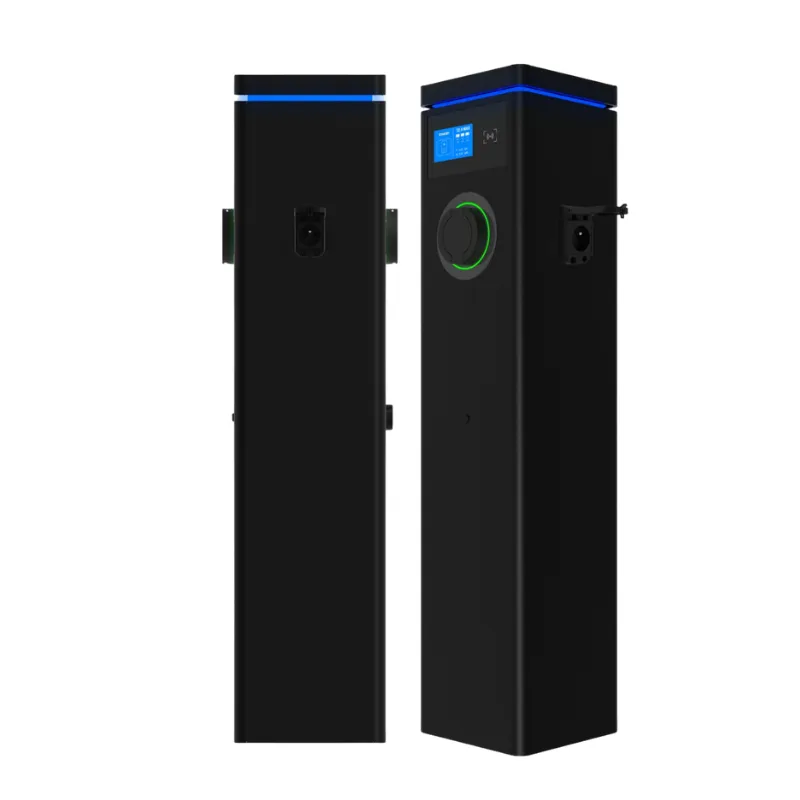
Pick on parking layout; the electronics are the same. The CPO wall box is 450 × 400 × 160 mm. The pedestal is 260 × 260 × 1140 mm and adds a display per point. A pedestal between two bays serves both without cable crossing and avoids wall-mounting costs; a wall unit saves floor space where a wall already sits behind the bays. Either way, the number of points sets installation cost more than the housing does.
How this relates to EVCSTAR equipment
The CPO Series is the dual-port AC range: 2 × 3.7 to 2 × 22 kW, IP55 and IK10, OCPP 1.6J and 2.0.1. MID meter and Payter card terminal are options, so you can quote the cheaper unit for private sites and the equipped unit for public ones. Price depends on configuration, so send your voltage, number of bays, connector standard and payment needs through the contact page and we will return a configured quotation. See the CPO Series page for the spec table, and use the payback calculator once you have a quotation.
Grid capacity calculator
- Spare power for charging
- —
- Input current per charger (400 V)
- —
- Chargers at full power
- —
Spare power = kVA × 0.95 power factor × (1 − margin) − existing peak load. Input current ≈ charger kW ÷ (√3 × 400 V), with power factor and 95 % efficiency added for DC chargers. With dynamic load management more chargers can share the same capacity at reduced power. Always confirm with your electrical engineer and the grid operator.
Frequently asked questions
- What does a dual-port 22 kW commercial AC charger cost?
- The price depends on your configuration, so send us your site data through the contact page and we will return a configured quotation. As an outside check, the US DOE cites about US$3,500 per public Level 2 connector and about US$2,500 average installation per connector, so a two-connector unit lands near US$12,000 on those figures. A 22 kW unit with MID meter and card terminal will cost more than the generic Level 2 figure, so ask us for a configured quotation.
- Do I need a card reader on an AC charger in the EU?
- For points deployed from 13 April 2024, AFIR requires ad hoc payment by a card reader, a contactless device, or, below 50 kW only, an internet-connected device such as a QR code. A 22 kW point can therefore use QR payment. Check national rules and your operator contract as well.
- Can my car actually use 22 kW?
- Only if its onboard charger accepts three-phase 22 kW, and many cars accept less. Check the vehicle data sheet for the maximum AC rate; the charger delivers what the car requests.
- What supply does a CPO44 need?
- Two points at 32 A three-phase need 64 A in total, which is 1.732 × 400 V × 64 A, about 44 kVA. Add margin, and use load management if the site current limit is lower.
References
- [1]Procurement and Installation for Electric Vehicle Charging Infrastructure. US DOE Alternative Fuels Data Center (citing NLR/INL).
- [2]Electricity Infrastructure Maintenance and Operation. US DOE Alternative Fuels Data Center.
- [3]Electric vehicle charging: new obligations (AFIR). Arthur Cox.
- [4]Electric Power Monthly, Table 5.6.A. US Energy Information Administration (August 2026 data).