State guide
EV Fast Charging in Queensland: Electric Super Highway and Heat
EV fast charging Queensland business guide: the 55-site Electric Super Highway, the closed $10M co-funding scheme, council sites and heat risk.
- Prepared by
- EVCSTAR Engineering Team
- Published
- Reading time
- 4 min
- Sources
- 5 references
At a glance
- Electric Super Highway sites
- 55 sites x 2 chargers
- Co-funding scheme (2022-25)
- $10 million, closed
- Max co-funding per project
- $3 million, under 50%
- Co-funded sites opened by Feb 2025
- 19 of 46 planned
Key takeaways
- 1The state-built Queensland Electric Super Highway is described by its operator as 55 sites with two fast chargers each, so the main coastal and inland corridors already have a public baseline; a new site competes with it, not with an empty map.
- 2The $10 million Electric Vehicle Charging Infrastructure Scheme (co-funding of up to $3 million per project, below 50% of project value) is closed with no further rounds planned, so a new Queensland site is normally privately financed.
- 3A field study in Qatar (2026) found an air-cooled DC charger lost up to 35-40 kW of offered power and nearly doubled session time (86 to 169 minutes) as rectifier temperature neared 55 °C: in Queensland, thermal rating and shade are a revenue question, not a comfort item.
- 4Land is where the state has already moved: councils lease car parks to operators (Maryborough: 10-year lease, NRMA, four fast bays), which is a cheaper route to a town-centre site than buying freehold.
On this page
Short answer: EV fast charging for business in Queensland means entering a state where the government has already built the corridor network and closed its grant scheme, so a new site wins on a specific location, a workable connection from Energex or Ergon, and equipment that holds its rated power in heat.
What the state has already built
The Queensland Electric Super Highway is the baseline you are measured against. Its operator, Yurika, describes it as 55 sites with two fast chargers at each, delivered in three stages (2017, 2021 and 2025). The state’s 2023 statement says the first site opened in 2017 and that sessions had passed 106,000 by then, which tells you drivers use these sites. A separate state program put new charging into towns away from the highway spine.
| Program | What it did | Source status |
|---|---|---|
| Electric Super Highway | 55 sites, two fast chargers each | Operator page, read |
| Co-funding scheme, stage two | $10 million; 44 sites in 30+ towns announced May 2023 | State statement, read |
| Scheme progress | 19 of 46 planned co-funded sites open at 4 Feb 2025; remainder due 31 Dec 2025 | QRIDA, read; no later count found |
Towns named in the 2023 announcement include Bundaberg, Gladstone, Mackay, Townsville, Cairns, Toowoomba, Gympie, Warwick, Moranbah and Alpha, with Evie, ENGIE, NRMA, RACQ and Tesla as delivery partners. None of the pages we read gives charger power, so check actual kW for each site on a charger-map app before you assume a gap.
The funding line has been drawn
Queensland’s money has been spent, so plan for private finance. QRIDA states the co-funding scheme covered charging equipment, energy storage, installation and commissioning, capped at $3 million per project and below 50% of the total project value. Private charging not open to the public, such as at apartment buildings or hotels, was excluded, as were sites funded by another grant. Applications closed in February 2023 and QRIDA says there are no plans for further rounds. The consequence for a business case: any site you plan should clear its return without a grant, and the payback calculator is the quick test.
Finding land without buying it
Council car parks are a working route. At Maryborough, Fraser Coast Regional Council ran a tender, and NRMA Electric Highways won it in May 2024 on a 10-year site lease. Four fast bays and two Level 2 bays opened in 2025; the article quotes about $20 for a typical fast charge and about 30 minutes for a full car charge, so treat that as the price point the market already sets. Funding was not stated in the article. A lease removes the land cost but ties you to the council’s terms, so read the exit and relocation clauses.
Heat, shade and what to ask for
In a hot climate, the charger’s own thermal limit is the risk, more than the car’s. The Qatar study measured an air-cooled commercial DC charger between 15 and 55 °C ambient. Output stayed close to rated at moderate temperatures, then offered power fell by up to 35-40 kW as rectifier temperature neared 55 °C and average conversion efficiency dropped by 5-8%. For the tested charge window, time rose from 86 minutes in winter to 169 minutes in extreme summer. The authors attribute most of the loss to the charger’s thermal protection, not to the battery.
| Design choice | Why it matters in Queensland |
|---|---|
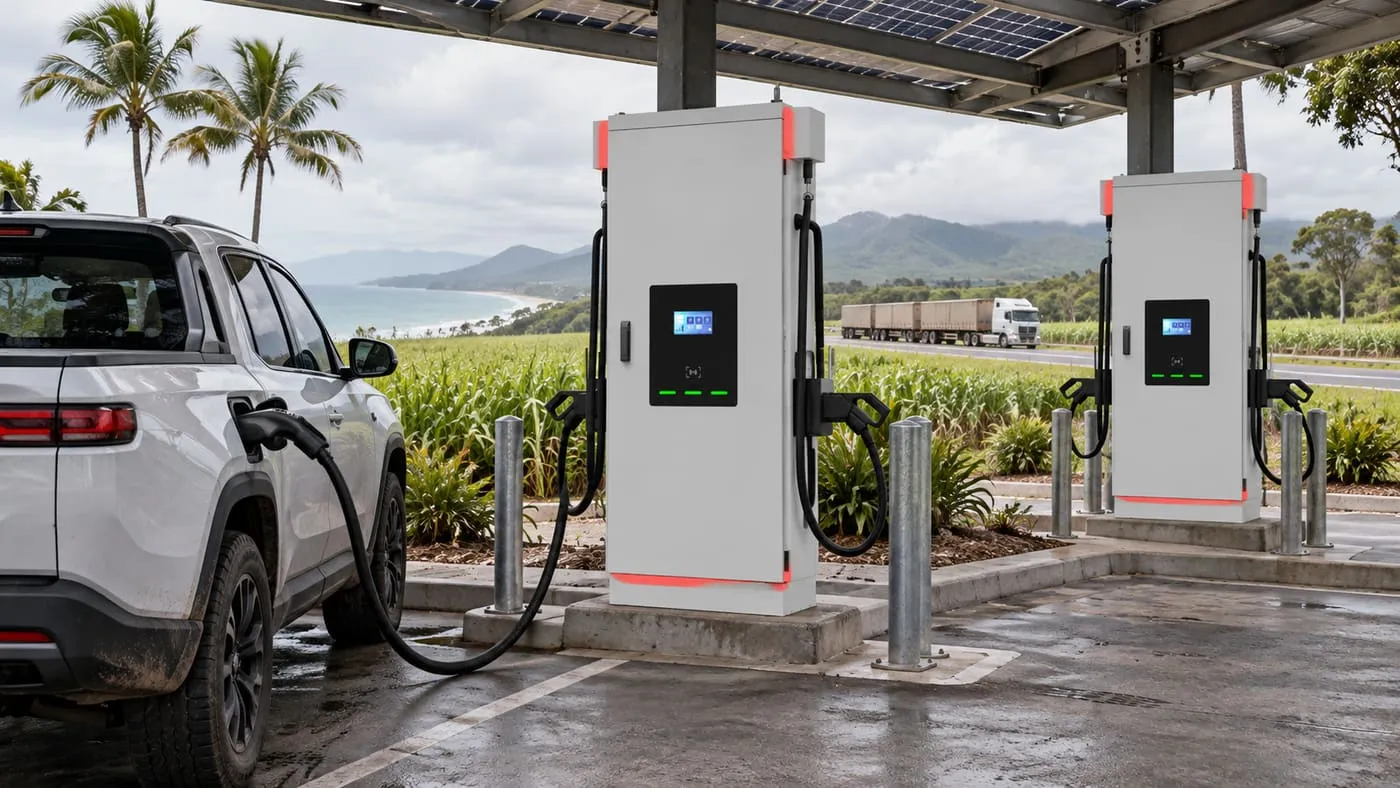
| Canopy over cabinet and bays | Cuts solar load on the enclosure and the car |
| Cabinet orientation and airflow clearance | Keeps intake air away from hot pavement |
| Ambient rating in the data sheet | Ask for the highest ambient with full output, not the operating range alone |
| Dynamic power sharing | Keeps the site connection, and its demand charge, smaller |
Qatar is hotter than Queensland, so use the study as a mechanism, not a forecast; we did not obtain Bureau of Meteorology figures for any Queensland town.
Connection: Energex or Ergon
Which network serves the site decides the process, and the answer is by address. Energex covers the south-east, Ergon Energy the rest of the state. Both are Energy Queensland businesses; their tariff guides and EV connection pages returned access errors for us, so the demand-tariff names, the rates and any rule on load control for fast chargers are not stated here. Send the network a connection enquiry with the number of guns and total kW, then size the supply with the grid capacity calculator and read our note on demand charges. Victoria’s separate network rules are on the Victoria page, and Sydney shows the New South Wales view; do not assume they transfer.
Choosing equipment for a Queensland site
European-style 400 V, CCS2 builds fit the Australian three-phase supply. For corridor hubs the UC series (60-360 kW, dynamic power sharing between guns) is the option to compare with the existing Electric Super Highway power levels. The CC series (120 and 180 kW) suits a town site with a limited connection, and the HC series (20-60 kW) suits destination stops where cars sit for an hour or more. All EVCSTAR chargers are specified to operate to +55 °C and support OCPP 1.6J and 2.0.1. We cannot state that any model meets Australian electrical approvals (for example RCM) or a network’s connection rules; we can supply test reports and technical documents to support your application.
To start, send us the town, the network (Energex or Ergon), the connection capacity offered and the number of guns you plan, via the contact page, and we will reply with a configuration proposal and a quotation breakdown.
Grid capacity calculator
- Spare power for charging
- —
- Input current per charger (400 V)
- —
- Chargers at full power
- —
Spare power = kVA × 0.95 power factor × (1 − margin) − existing peak load. Input current ≈ charger kW ÷ (√3 × 400 V), with power factor and 95 % efficiency added for DC chargers. With dynamic load management more chargers can share the same capacity at reduced power. Always confirm with your electrical engineer and the grid operator.
Frequently asked questions
- Is there still government money for a private fast-charging site in Queensland?
- Not from the scheme we read. QRIDA says the $10 million Electric Vehicle Charging Infrastructure Scheme covered capital and installation costs (up to $3 million per project, under 50% of project value), applications closed on 6 February 2023, and there are no plans for further rounds. Check QRIDA and your council for anything newer before you finalise a financing plan.
- Which network company will connect my site?
- Queensland has two distribution networks, Energex in the south-east and Ergon Energy across the rest of the state, both part of Energy Queensland. Which one applies depends on the address, and we could not open their connection or tariff pages (access blocked), so we cannot quote their fast-charger rules, demand tariffs or load-control requirements. Ask the network for a connection enquiry with your kW, gun count and location before buying land.
- Do I have to worry about heat if I install a DC charger in Queensland?
- Yes. A 2026 Qatar field study of an air-cooled commercial DC fast charger found offered power dropped sharply as rectifier temperature neared 55 °C, with up to 35-40 kW lost and a charge window taking 169 minutes in extreme summer against 86 minutes in winter. Queensland is milder than Qatar, but a black bitumen forecourt in full sun in a tropical summer is the same problem in smaller form. Ask any supplier for the ambient rating and derating curve in writing, and shade the cabinet.
- Can a council car park work as a site?
- Often yes. Fraser Coast Regional Council opened six chargers (four fast, two Level 2) at the Brolga Theatre car park in Maryborough, delivered by NRMA Electric Highways, which won the tender in May 2024 and leases the site for 10 years. Other councils may run similar tenders; ask the property team for any open expression of interest.
References
- [1]Queensland Electric Super Highway (QESH). Yurika.
- [2]Electric vehicle charging infrastructure scheme. QRIDA, Queensland Government.
- [3]Ministerial statement, 25 May 2023: 44 new EV chargers in more than 30 towns. Queensland Government.
- [4]Impact of extreme climatic conditions on fast EV charger performance: field experimental insights from Qatar. Energy Conversion and Management: X, vol. 31, 2026.
- [5]Fraser Coast unveils six new EV chargers. Inside Local Government, 3 June 2025.